









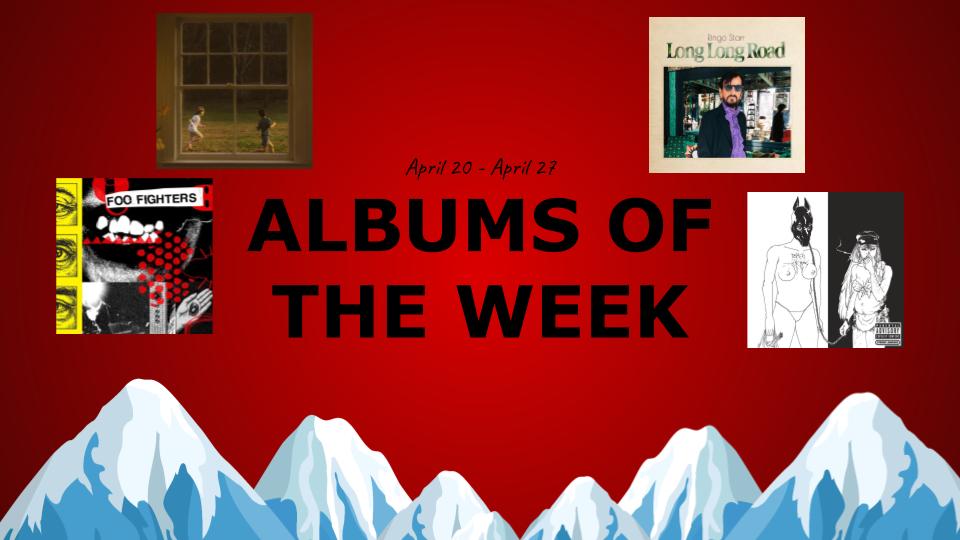






This week, I’ve got another four albums for your listening ears. There will be three new albums from the past week (on a monday to monday basis) and one classic album we’re celebrating the anniversary of.
This is the final release of the Spring 2026 semester, thanks so much for all the support throughout this semester and the last. Here’s to many more albums of the week in the future.
If there’s an album YOU want to see covered that we missed (or a review that you disagree with) write a review of your own and submit it right here!
Your Favorite Toy – Foo Fighters
6.1/10

The Foo Fighters are in my opinion a pretty underrated album band. I’m not calling them underrated in a large sense, hits like “The Pretender” and “Everlong” are not only great songs, but also extremely popular ones. Despite this, a lot of their earlier records have tons of deep cuts that are more than good enough for me to give Foo Fighters the title of “album band”, opposed to a “songs band.”
While they kind of lost their footing after the 2000s, it was the unfortunate death of drummer Taylor Hawkins that gave primary songwriter Dave Grohl the kick he needed to return to form with 2023’s “But Here We Are”, and while this album doesn’t replace their self-titled or “The Colour and the Shape,” it’s still a ton of fun, and shows that for better or worse, “unc still got it.”
With a grin on my face only as big as Grohl’s when he gets to impregnate a groupie, I am proud to say this album was also a lot of fun. It goes for a super gritty take on their sound, with a far rougher, distorted feel that’s more comparable to their debut “Foo Fighters” than anything after. I really like this ability to produce a different sound even after decades of sticking with the same one and it’s definitely to the benefit of the record.
Now, let’s be clear: at only 36 minutes across ten songs, not a lot is being accomplished outside of the average track being rougher than most other Foo Fighters records. A couple songs on here aren’t even that rough. Through the back-half of the record things brighten up and there’s a few songs more akin to a traditional outing from them.
The songs are all fun, the choruses are catchy and the drumming is of course incredible. Grohl’s voice has aged shockingly well and the fact he can not only sing like he used to be able to, but also scream like he could? It’s really impressive and allows the record to sound like something that he could put out in his prime, unlike other artists whose voices haven’t held up.
Is there anything bad about this record? No, not really. It’s exactly what you’d expect. Is there anything good, though? Well, there’s nothing outstanding that’s for sure. Despite that, I do really love a lot of the singles. Opener “Caught In The Echo” has been stuck in my head since it was released as a single, title track “Your Favorite Toy” captures the energy of this record really well and when they do slow it down for pieces like “Unconditional”, they still work out to be good tracks.
I love Foo Fighters, alright? This record is certainly not amazing and as a whole doesn’t approach their previous peaks, but there are plenty of singles from this album that are really enjoyable and do manage to stand tall alongside singles from days gone. If you like Foo Fighters, give this record a listen. If you don’t, this definitely isn’t the album to get into them with.
Long Long Road – Ringo Starr
5/10

The SECOND album from Ringo Starr that explores this new country sound he’s going for, “Long Long Road” is not going to blow your socks off.
Ringo, I love you man. I really do. I would absolutely have loved for him to go the way of fellow Beatle George Harrison and have an insane, break-out solo career. His two solo credits during his Beatles tenure in “Don’t Pass Me By” and “Octopus Garden” are both great tracks, and when they gave him a track to sing, it always feels like a treat. One then has to wonder, where did it all go wrong? I think the answer is that it never did go wrong and that while he’s never had a truly great solo album, he’s never had a truly bad one either.
Just as expected, this album isn’t bad, but definitely isn’t good either. Contemporary country is joked on so often and many people consider it the worst genre of all time. I definitely don’t agree with that take but it can be hard to make it sound good. While this album doesn’t exactly sound Jason Aldean “Big Green Tractor”-esque, it’s damn close and while Ringo can try to pull it off, it feels a bit of an ill-fitting guise for the drummer more often than not.
So many of the songs sound so similar, and considering the record is only 33 minutes, there’s not a lot of room for variety here. The creativity here is not non-existent, but is pretty weak and there’s nothing standout.
Ringo’s voice works pretty well for the country sound he’s going for and while he is often joined by backup vocalists, he does sing lead for the entire album. It sounds slightly adjusted, some songs more than others, but based on how well he’s aged physically, I wouldn’t be surprised if the production just gave it an odd vibe and he still sounds the exact same. The occasional slide guitar solos that appear throughout the record are pretty pleasant too. I actually think a good slide guitar solo is what separates slop, republican-coded country music from the actual good stuff.
This leads me to my main problem with the record. Out of the ten tracks, the “Starkey” credit only appears on three of them. All the other tracks are written by one “T Bone” Burnett, the producer and dominant ghostwriter. No hate for Ringo, of course, but the three by him are some of the ones I liked the least from the record. That’s a bit sad, no?
I don’t think this record is worth anybody’s time. I rarely revisit Ringo’s solo work (though I do have a soft spot for 73’s “Ringo” as it’s the last release to feature all of the fab four on one album) and this one I don’t think I’ll ever listen to again outside of showing a less-versed friend “Hey, did you know Ringo Starr makes country music now?” for a quick laugh.
Despite this, I have heard the two are getting back in the studio to work on Paul McCartney’s solo record and I hope they can shine brighter there. This album? It was a waste of time.
The Great Divide – Noah Kahan
3.2/10

If you live in Asheville, you know that Noah Kahan is basically the patron saint of modern folk pop for Generation Z around here. I’ve got nothing against this guy, but I just never gave him a fair change. Leading up to the release of this record, I did that, and I also spent quite a while with this record trying to figure out what I thought about it.
“I describe this album as like I’m in the shower and I’m half yelling at the showerhead and pretending it’s whoever I want to talk to and taking responsibility or throwing blame, like those conversations that you wish you could have with people but have never been able to,” Noah Kahan tells Apple Music.
Here’s a conversation I wish I could have with you, Noah: Please retire.
In a world where pop music is slowly cannibalizing itself, I was so desperate for a folk (or folk-adjacent) artist to do something that would grant the masses a reprieve from the ai-generated drownings of Sabrina Carpenter’s latest, or whatever else is on the radio. This album is absolutely not that. If you enjoyed the empty, mountain-esque guitarisms of “Season of the Stick”, you’re in for a sucker punch as the record opens with the horrendous “End of August.” It’s overproduced and features free-sounding, baby’s first synths that mark the Imagine Dragons inspired chorus.
Kahan doesn’t use his vocal talents for anything on this track, he’s keeping himself in a basic, plain, derivative range that barely changes throughout the song. The same can be said for the followup “Doors.” The two songs are not only both terrible, but nearly 1:1 copies of each other with the repetitive verse, uninspired progressions and stomp-clap-hey chorus.
Sometimes, he tries to go back to folkier roots, like the next song “American Cars.” Just kidding! The semi-interesting banjo plucking that marks the intro is quickly swept up by cheap, midi snare hits as the song devolves into yet another boring take on the exact same song we just sat through twice before. This song is one of the worst to hear because he actually lets his voice shine here. His voice is really good when he wants it to be—like on this song—but god, it’s bottlenecked by the truly terrible music. “Singer-songwriter is about the vocals and lyrics, not the music,” I hear you say. Guess what: if the vocals suck 90% of the time, and the lyrics suck 100% of the time, it’s bad music whether it’s singer-songwriter or not (it’s not).
I could really go on and on about the lyrics. Some genres I feel just do not benefit from swearing. I understand that I sound like a grandmother accusing her grandchild of being a “hussy” because she wants to wear shorts, but it sounds very corny when done incorrectly in most non-hip-hop genres. Nearly every track here features some kind of swearing and whether its a simple “shit” thrown in or a powerful “fucking”, I hate them all the same. It takes me out of it. When one is writing a record as emotional as Kahan would like this to be, it makes sense to put pen to paper and see what comes out: hence the swear words. They still sound goofy though.
This is a pattern that repeats for pretty much the entire record. Boring verses with overproduced guitar (killing any folk inspirations Kahan may try to bring) lead into equally bad choruses that belong on a Hobo Johnson record more than anything. Do you like Panic! At The Disco? Then you’ll love Noah Kahan! Do you like Meghan Trainor’s hit single “All About That Bass?” Then you’ll love Noah Kahan! Do you like bad music? Then you’ll love Noah Kahan!
It’s the kind of music that’s grown in a lab to try and make the radio. It’s the kind of music that’s playing at your grandparents house on a video entitled “Greatest 100 Folk Hits Of All Time” and you have to politely take the remote from them and say “Grandma, these songs are ai-generated.” It’s the kind of music that makes you do a double take when somebody says they actually like them.
That’s what really pains me about hating this record on the whole. There are times throughout when I see that sparkle of classic, Appalachian folk that makes me want to love it. If he were to go the way of “Season of the Stick” and strip things back I wouldn’t mind the occasional stomp-and-holler tracks, especially the better ones. “Haircut” does everything I would want from a contemporary folk pop track without sounding corporate or Taylor Swift-adjacent. “Dashboard” manages to balance these rockier elements and the result is a relatively powerful, emotional song. A few of these amidst an otherwise good record would be fine; they’re not amidst a better record though. These aren’t good songs and I’m forced to portray them as such because of the sheer horrendousness the rest of the record is.
Even when he sheds this lame, radio pop tone he still can’t fully escape its influence due to the atrocious production. I’ve never heard a producer do so much to try and make an artist sound worse. Look at a song like “We Go Way Back.” It features minimal to no drumming, decent lyricism and pretty solid vocals. Well, they would be solid vocals if they weren’t mixed to sound like he needs to shout them over a cheesy synth melody. Recorded differently this track—and the entire album—would be so much better; this track just happens to be the perfect example of how detrimental it is.
At a whopping 77 minutes, I’d be shocked if the CIA hasn’t adopted this as a new torture method. Long albums are great, and oftentimes better albums are longer, but no album that sounds this bad for this long should be 77 minutes. 77 minutes that you could spend listening to a near-infinite number of better albums. I truly love folk music and to see it bastardized, eviscerated, have its corpse strung up and surrounded by dance circles like is done on “The Great Divide” makes me so sad. This is made worse by the fact that with his guitar playing skills and vocals he really could make a damn good folk record. He could successfully imitate the likes of Nick Drake or Roy Harper. Instead, we’re subject to this hell. He really is talented and instead spends his time making 77 minute, 17 track long spotify optimized garbage.
Like I said, Noah: Retire
The Money Store – Death Grips
9.3/10

“Now we’ve got all the coconuts bitch!”
I could start this by saying that “The Money Store” is one of the best industrial hip hop albums of all time. I could go beyond, and start this by saying that “The Money Store” is one of the best hip hop albums of all time, no sub-genre needed. Instead, I think I’ll start by saying that “The Money Store” is one of the best albums of all time—full stop.
The first adjective that comes to mind when I think of this piece is “inventive”. It is really, really hard to find something that sounds like “The Money Store”. From Stefan “MC Ride” Burnett’s vocals to Zach Hill’s insane drumbeats, there’s a near infinite amount of variety to be found across the just 41 minute long record. MC Ride can both shout until he’s breathless, or calmly talk-rap into the mic. His vocals are the clear highlight for me. More often than not, he’s going all out and combined with the industrial, pumping, electronic production behind him, it feels like the foot is on the gas for almost all of “The Money Store.”
Drums clatter and bang, like slamming machinery and whirring saws. Synths clash with each other and still come out the other side maintaining a melody. Samples are utilized to their fullest extent, and while not super common, when they appear it’s always a treat. “Hustle Bones” features some arpeggiated vocal chops that add a strange brightness to the otherwise very dark piece.
Tracks are at their best when they follow this pattern. Dark, depraved and futuristic but with a weird glimmer of hope that you’ll escape whatever twisted fantasy each song traps you in. “Double Helix” features these heavy, reverberating gong-esque sounds that loop throughout the track over banging crash cymbals and rapid hats. “Punk Weight” features these aggressive, club-like drums that pound you through the chorus and keep the energy endless. There’s a synth sample here that sounds like a shout, played over and over again that it sounds like a ray of light reflecting around some giant, dim room.
While I touched on them before, MC Ride’s vocals really are special and while Zach Hill’s production is mind-blowing at times, Ride’s the one who leads the charge. He’s manic with his tempo changes. Like I said, he can go till he’s breathless with how loud and fast he is, but he can also keep the energy and draw back the tempo which leads to more drawn out displays of force. While it’s normally a heavy, dense vocal experience, there are times when he can get more melodic and when these sections do pop up, they’re a huge treat. “Bitch Please” features him damn-near singing along to Hill’s melody in the background, “Get Got” and “Double Helix” feature a quieter, more traditional hip-hop rapping style and there are moments throughout other songs where he steps away from shouting endlessly.
Good vocals mean nothing if there’s no lyrical substance to them, and there certainly is. While there’s not a coherent enough story arc to make “The Money Store” a true concept album, there’s plenty of connective themes to tie it all together. Paranoia and paranoia-causing mental disorders (like schizophrenia) are covered time and time again here. “The Fever (Aye Aye)” and “I’ve Seen Footage” both cover the idea that something is being hidden by the powers that be. “Get Got” follows various vignettes of a police chase that the speaker barely even comprehends is happening. “Who drove the car? I’m still alive, Up in smoke, moon was low.”
The main theme though, is violence. A lot of violence. Most of the songs cover some kind of violence, but it’s more apparent at some times than others. “Fuck That” features lines like “Cut your brain stem as my combat boots grind your head, To the cadence of this dreath stompin’ mu” and “Came ta bad dem brains ’til dem neck bones crack, Arrested cardiac, black mass murder rap”. Other tracks like “Punk Weight”, “Hacker” and “Blackjack” are about similar criminality; with other topics like drugs being weaved into the themes of violence.
This album does avant-garde extremely well. Weird vocal chops mixed into futuristic, cyberpunk-esque electronic sounds, drums sampled from god-knows-where (a Serena William’s tennis match, perhaps) and MC Ride’s ever present stream of consciousness ranting all add up to make a really bizarre experience. If the entire record was like this, it would be a great record, and I would still love it. It’s Death Grip’s ability to veer into a more pop rap, melody-reliant sound at times though that really makes them incredible. You can’t break the rules without knowing what they are, after all.
“I’ve Seen Footage” is a phenomenal track, and extremely fun in an otherwise somewhat scary album. The melody is guitar-esque with how rough and gritty the saw lead is, and it lends itself to this more traditional sound. There’s a shocking lean into a verse/chorus structure in this song here too. The lyrics are great here too. The chorus is just over and over “I’ve seen footage!” on repeat and in tandem with the melody it’s super catchy.
Hill says the lyrics came from a conversation with a “street person” in Sacramento, saying over and over that there were structures on the moon, and that he’d “seen footage”. The piece also occasionally has Ride chant “I stay noided”—both meaning that he stays on noids to cope with seeing forbidden footage and that he’s extremely paranoid because of the footage. A great double entendre but moreover just a really fun line to sing.
“‘The line “I’ve Seen Footage’ was from a conversation I had with this street-person dude in Sacramento named Snake Eyes. A friend of ours recorded him on the porch in a conversation– he didn’t know he was being recorded. He was all fucked up on drugs and shit, just rattling off all this crazy information. He was talking about structures on the moon. I mean, I talk about those things, too. So we were talking about moon structures, and Snake Eyes says, ‘I’ve seen footage! I’ve seen footage of it!’ And I was like, ‘That’s good,’” Hill told Pitchfork in 2012.
The other big hit from the record is the closing track, “Hacker.” It starts like any other track on the album, aggressive drumming, bizarre melodies appearing and disappearing. Ride’s signature ranting, mostly off tempo. That’s before a sudden choir-esque hit jumps in and leads him into a melody with a catchy chorus. “I’m in your area, I’m in, your area,” over and over behind ascending synth melodies. Less ubiquitous than “I’ve Seen Footage”, but a song that better represents what Death Grips is about, and a better song overall in my opinion.
The lyrics tell a story of a gang of spies, murderers and other sorts of criminals going on a rampage, attacking department stores, grave digging, kidnapping children and really any ill-begotten behavior you can imagine. The descriptions are pretty gruesome too. Stuff like “Grab your fucking chain and drag you through the bike lane, While everybody’s like (Nooooo!)” or “Gaga can’t handle this shit, headed for the Sammy Davis wing”, the latter half of that line implying they’re heading out to kill cancer patients. Why? Because they’re in your area.
While Death Grips have so many classic records, there’s a reason why “The Money Store” is their highest regarded. It captures Death Grips so well, and for such a short record—comparatively to the amount of ideas it explores—that’s damn impressive.
Not many people can appreciate Death Grips. I don’t mean to sound like an elitist (though I am) but unfortunately it’s just the way of experiential hip-hop that not everyone will like it. For those willing to take a chance though, they’ll be rewarded with an unquestionably phenomenal record.