






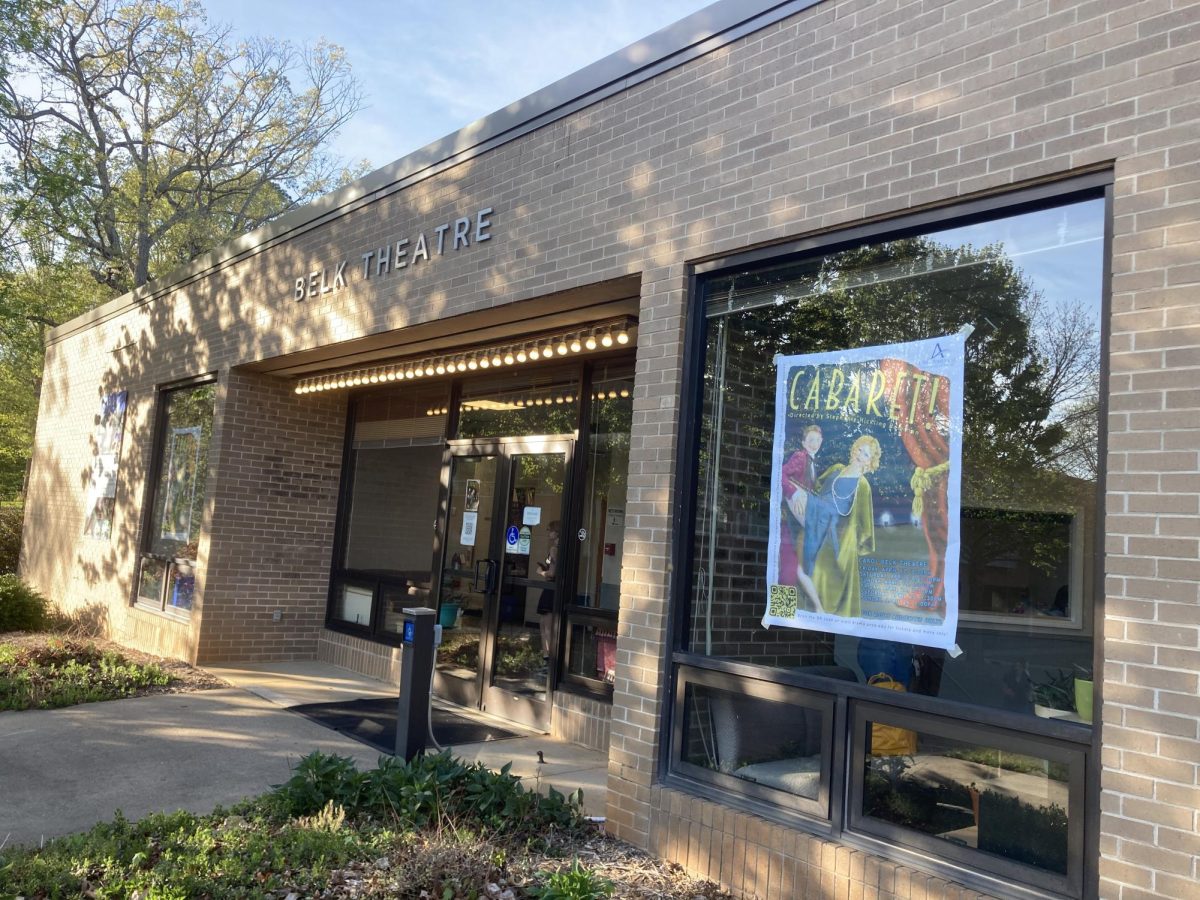

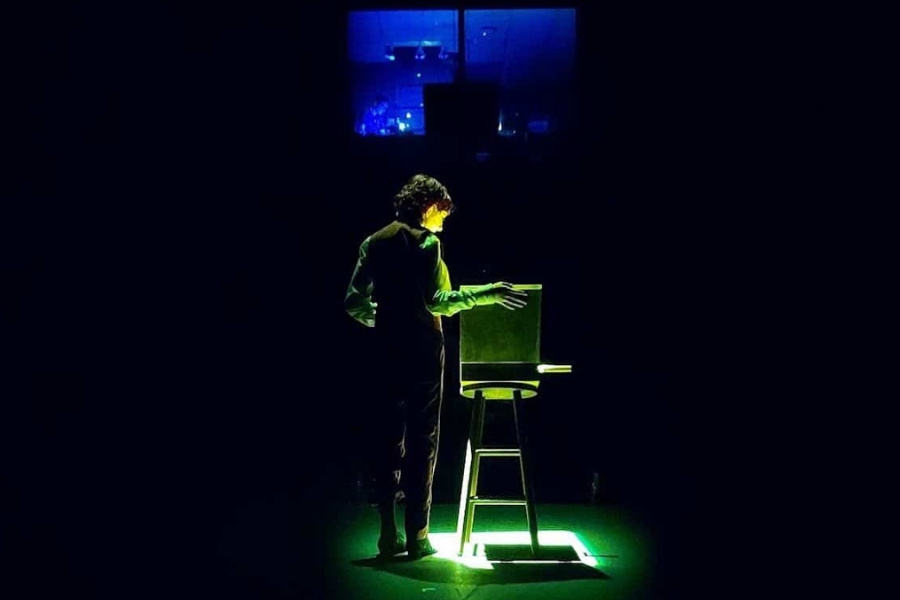










The opening night performance of “Cabaret” moved me immensely. It was bound to— it’s sadly the drama department’s final show and they threw the rest of their budget at it. But despite that tragedy, I left the theater overcome with gratitude for my community at UNC Asheville.
***
We nestle into our seats at Belk Theater. We ooh and ah at the set design— namely, the large KIT KAT KLUB light sign, which features a winking cat peering down on us all.
The stage takes up the whole center of the round theater— there’s an elevated stage, but also chairs and tables set in front of it to form an “audience” for the club, with telephones on each table. Maroon curtains drape on the sides of the stage and around the theater.
We wait for the show to start. We bump our heads enthusiastically and tap our feet as the band plays a few swanky tunes from their perch above the elevated stage. Although many of the band members are rendered unrecognizable in their costumes, I catch the eyes of some familiar faces from the music department and wave up to them.
CK Custance runs out onto the stage— hey, I know that guy! CK recites the customary announcements and a land acknowledgement before the show. They run off. The lights go down.
Then, that signature dramatic drum roll and cymbal crash comes barreling towards us, opening the show. The Kit Kat Klub’s Master of Ceremonies (the emcee), played by Max Thompson, appears.
Now’s the time to mention that Max Thompson is a good friend of mine. Max is one of those people you can’t help but love— his goofy smile, his propensity for ridiculous humor while also being a goodhearted, sensible person— and I relish seeing his friendly countenance at the dining hall where I work and around campus. We always have a hoot. I was elated to see he was cast in the show, along with many other friends and acquaintances of mine.
In his purple suit, complementing his purple hair, the emcee warbles out the opening lines of “Willkomen” and does a great job warming us up. His delivery is deliciously cheeky as he tells me to leave my troubles outside.
“Life is disappointing, isn’t it? Forget it— we have no troubles here! Here, life is beautiful. The girls are beautiful. Even the orchestra is beautiful!” he exclaims.
The band takes off in a gallop. The aforementioned girls come out, their arms swinging and yes, they are beautiful. It takes a moment but I figure out where I recognize their faces— all of them are people I regularly see around campus. Most of them, I had no idea they could dance or perform— certainly not like this!
The emcee introduces the cabaret boys. I’m delighted to see that one of them is played by Marcos Martinez, incumbent SGA president and one of our school’s last drama majors.
The emcee runs off the stage and up into the audience, towards where I’m seated with my friends Victoria Renville and Mick Palmer. He comes to us, gestures and I giggle as he asks us if we’re enjoying the show in his theatrical, vaguely French-German accent. Then he pops away, back to the stage.
It’s a wonderful mess of legs and arms, lights and percussion, delight and delirium. The whole spectacle is outrageous, glorious, beautiful— and then it’s over.
The stage becomes a train headed into Berlin. We’re introduced to young American writer Cliff Bradshaw, played by Jensen Cairen-Kelz.
I don’t know Jensen personally outside of seeing them around campus, but I quite like their portrayal of Cliff. They play the character with quite a bit of young-man-in-a-new-city nervousness, but not to the point where Cliff could come off as too much of a coward— because he’s certainly not.
Cliff encounters German smuggler Ernst Ludwig, played by Koen Burham— wait, that guy looks familiar. I know him! He was in my first mass communication class last year and has a splendidly resonant voice. Wow, he’s doing a great job. I think all this to myself as the scene barrels on.
Ernst Ludwig offers Cliff some black market work and recommends him a place to stay. Cliff checks the place out— it’s a boarding house run by proprietress Fräulein Schneider, played by Rachel Huneycutt.
I’ve had a few limited interactions with Rachel here and there. She seems a friendly, bubbly gal with cute sweaters and a sweet smile— but all of that has disappeared in her portrayal of stern Fräulein Schneider.
Cliff and Fräulein Schneider have a disagreement on the cost of one of her rooms, but she relents and allows him to stay for half the original price. Then, she rolls into “So “What?”— one of my favorite songs from the show, where Schneider comments on how she’s learned to accept whatever life offers.
“For the sun will rise and the moon will set, and you learn how to settle for what you get,” she sings. “It will all go on if we’re here or not, so who cares? So what?”
Then we’re back at the Kit Kat Klub. Cliff’s there, too, sitting in the audience in front of the elevated stage.
The emcee comes out again, to our cheers, before introducing the heroine of the show— the deeply troubled English chanteuse Sally Bowles, played by the wonderful Finch McGowan.
I first encountered Finch back when I lived in Charlotte. It was a funny interaction. I had recognized him, at a comic convention, from his Twitter account and referred to him as “Finch from Twitter.” It caused a great laugh. We hung out a bit, he busted out his Suzuki Omnichord— truly, I didn’t make this up— and we duetted a Fiona Apple tune. A remarkable first impression. I was delighted when Finch transferred to UNCA.
“Mama thinks I’m living in a convent— a secluded little convent in the southern part of France,” Sally starts. “Mama doesn’t even have an inkling that I’m working in a nightclub, in a pair of lacy pants!”
We hoot as Sally reveals the bloomers under her costume. Then the lovely cabaret girls appear back on stage and the song launches into another raunchy spectacle.
My eyes can’t help but fixate on one of the cabaret girls— Rosie, played by Dani Cox, who is dancing her ass off. Her face is wonderfully emotive as she moves, her limbs stretch out beautifully and every movement sits right in the pocket of the rhythm, landing perfectly with the beat. She certainly grasps the little nuances of Fosse style. It’s hard not to just watch her the whole time.
I had no idea that Dani, as I know her from working together at the dining hall, could perform like that. My mouth sits agape for the rest of the number. When it’s over, my friend Victoria leans over to compliment her.
“She’s insanely good,” I respond. “I had no idea she could do that.”
The show continues on, but something else occupies my mind. I’m thinking about the fate of the drama department at UNCA. I can’t help it. It’s sad. Our school is changing— of course, it has to change in order to survive. At least, that’s what I’m being told.
I want to enjoy the decadent and depraved spectacle unfolding in front of me, but I just can’t tear myself away from my thoughts. Many of the people in this cast will be the last graduating drama students at this institution. I can’t believe that’s it. I can’t shake that thought— I can’t believe that’s it.
But so what? What good is made of worrying? Should we just learn to settle, as Fraulein Schneider sings it, for what we get?
No, that can’t be the solution. That can’t be the lesson here. After all, what “Cabaret” practically yells in its audience’s face is that we must fight complacency. Never settle.
However—and here comes a radical suggestion—maybe we should perhaps take advantage of what we have while we have it.
Because, yes, it’s sad that we’re losing theatre at UNCA. It’s horrible. To me, it mirrors the exact creeping terror that “Cabaret” warns us about— how something beautiful and vital to humanity can slip away while people are too distracted, too tired, too willing to accept “so what?” as an answer.
But as I sit here in Belk Theater, surrounded by my friends, watching my peers give their all to this performance, I’m reminded that art doesn’t disappear so easily. Not really.
It lives in the people who make it— in Max’s irreverent grin, in the lovely electric eccentricity I associate with Finch, in Danielle’s razor-sharp precision when she moves and in the band’s brassy pulsation overhead. It lives in the audience’s gasps throughout the show, in the uncomfortable laughter we can’t suppress and in the stunned silence that comes when the show’s over.
Maybe what makes this all feel so urgent is that this exact kind of togetherness isn’t guaranteed to us forever.
College exists as a strange, suspended world where we’re surrounded by people our own age, people we recognize, people we can walk up to after the show and say, “You were incredible,” and mean it. It could be one of the last times in our lives where self-expression feels this possible, even encouraged— where you can dye your hair purple, don drag in the school musical, bare your soul to everyone and be met with applause instead of confusion.
Outside of this bubble that is college, life begins to fragment. People move away, schedules get tricky, communities scatter. You don’t always get a room like this again— one full of familiar faces, full of possibility, full of people making things just because they can.
“Cabaret” is about denial, distraction and choosing decadence over confrontation until it’s too late. I think it was a wonderful choice for the department’s final hurrah and I’m glad I got to see it. It was capital-I Insistence— a group of people from our community coming together to say, “We’re still here, we’re still going to make something and it’s going to matter.”
Perhaps that’s the point— not to accept the loss quietly, nor let it consume us entirely, but to bear witness by showing up, paying attention and celebrating what’s in front of us while also refusing to forget its value once it’s gone.
Good for them. I’m glad the drama department refuses to go gently into that good night.

