











Park Chan-wook’s “No Other Choice” traps the viewer inside the claustrophobic machinery of capitalist logic, then grinds forward with hilarious momentum.
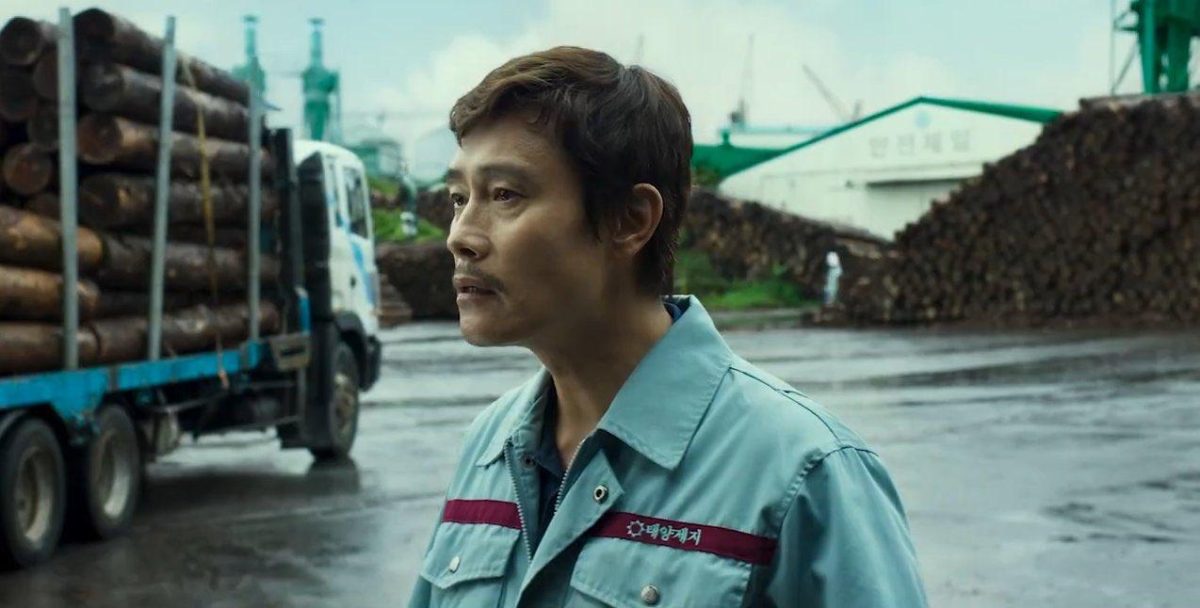
After an opening vignette establishes the idyllic life of patriarch Man-su — his wife, two children and two dogs enjoying grilled eel bathed in golden light — the film abruptly cuts to the metallic din of his workplace. As the camera pans across the vast paper manufacturer Solar Paper, Man-su’s voiceover asserts his frustration at being forced to lay off hundreds of employees following a buyout by an American company. The speech initially sounds defiant, until the camera reveals Man-su rehearsing it nervously to three co-workers, sweat-soaked notes scrawled on his palms. He is neither a leader nor a skilled orator. When he finally attempts to confront the departing American executives, he bungles the encounter. One black-suited executive dismisses him with the film’s title as he climbs into an SUV: “There is no other choice.”
What follows is a kinetic black comedy and a bloody examination of what happens when that phrase is carried to its warped logical conclusion.
Unlike similar heavy-handed South Korean films about the dire straits of life under capitalism, Park directs with a lighter touch. Throughout he makes lilting commentary on multiple crises of an economic system shaping every facet of Man-su’s life: masculinity, the nuclear family, gender roles, unemployment, childhood, intimacy and love.
Man-su searches stubbornly for engineering work in high-quality paper production, refusing to accept anything beneath his former status. He will not change careers, and he will not even visit a dentist to treat an infected tooth even when his wife, Mi-ri, begins working as a dental assistant. The family sells their house, sends their beloved dogs to the grandparents, cancels Netflix and trades luxury cars for economy models. As they slide from upper-middle-class comfort, Man-su’s latest job search ends with him begging on his hands and knees. From that humiliating point, he decides that he, too, has “no other choice” — and resolves to eliminate his competition.
Posting job ads for a fake paper company, Man-su identifies five men likely to be hired over him and compiles a hit list. The first murder goes chaotically awry but succeeds through sheer inept persistence. Man-su then juggles family life, deepening insecurity and four additional killings. His son even turns to petty theft to help ease the family’s financial strain.
The final target, Seon-chul, is a social media-savvy professional who seems to embody everything Man-su wants to reclaim. He lives in a picturesque country home, drinks whiskey, chops wood and holds the coveted position at Moon Paper. Man-su, posing as an admirer of Seon-chul’s Instagram, arrives bearing expensive liquor. The two drink heavily, culminating in Man-su extracting his own decayed tooth before suffocating a helpless Seon-chul in a harrowing scene.
Man-su achieves his goal. He is offered Seon-chul’s former job, keeps the house, reunites with the family dogs and enables his youngest daughter —a gifted cellist — to resume lessons.
The film ends with Man-su gleefully waltzing through another paper factory, but this one is fully automated. There are no workers. AI-controlled machines haul massive paper spools through near darkness as Man-su monitors production alone. The most horrific moment in the entire film.
“No Other Choice”, though imperfect, is wildly entertaining while pushing capitalism’s irrationality to its logical end. If executives claim there is “no other choice” but to sacrifice workers at the altar of perpetual profit growth, it follows — grotesquely but logically — that a desperate man might apply the same principle and kill for employment. The film’s absurd violence and obscene reasoning leave the viewer asking whether there truly is no alternative.
If automation can eliminate the need for human labor, why must those without work suffer? Should such advancements not benefit society as a whole? The American executive is correct in one sense: within capitalism, there is no other choice. The alternative would be a fundamentally different economic system. One not rooted in private corporations exploiting working-class labor to accumulate vast wealth for the few. One that doesn’t reward hoarding technological gains that could otherwise improve lives but ravage the planet and deepen human suffering.
When Geoffrey Hinton, the Godfather of modern AI, was asked how such technologies might be used equitably and sustainably, he offered a blunt answer: “Socialism.”
“No Other Choice” is currently showing at the Fine Arts Theater in downtown Asheville. Reduced ticket prices with valid student ID.