
























With recent data revealing a vast 53% increase in homelessness from 2020 to 2025 in Asheville, poverty educator and community advocate Kelly Redfern said that she’s seen the rise.
“Most importantly, I’m just eyes watching. I have been a quiet observer for eight and a half years, until I couldn’t be quiet anymore,” Redfern said.
Redfern also said that the method used by the Asheville-Buncombe Continuum of Care to count the amount of homeless people in Asheville is not enough.
“They don’t get the numbers right, because to be quite honest, and witnessing it in 2 years time, they have only paid themselves a payroll to think about it, to never implement,” Redfern said.
The jump in homelessness is 53% from 2020 to 2025, according to information in the Homelessness Management Information System, and this rise is paired with sharp increases in the amount of unsheltered people, with the number jumping from 65 in 2020 to 328 in 2025 according to the Point in Time count.
“The first year, I’m raising my hand, going, your numbers are way off, like, do you want money from the HUD or not? If you’re not citing these humans, you’re not going to get the funds,” Redfern said.
Information on how many people experiencing homelessness at a given time comes mostly from the HMIS and the Point in Time count. The Point in Time count is a vital resource, not only to count the amount of people experiencing homelessness in an area, but to secure aid from the US Department of Housing and Urban Development.
“The Point in Time count is done one night and then the following day,” Redfern said. “And they’re choosing a Tuesday night and a Wednesday day and they’re only going to Haywood.”
Redfern said that resources in other areas are overlooked when it comes to the Point in Time.
“As they push them out of downtown, they’re all over here and if they don’t do the count over here, as we request, they’re never going to get the numbers,” Redfern said. “But they don’t give a shit, because they’ve got enough to sustain their small program of a little administration that only talks about what they’re going to do.”
According to Debbie Alford, the CoC’s Homeless Strategy Specialist, the 2020 pandemic highlighted flaws in the Point in Time system. Alford says that the way the PIT count was conducted starting in 2024 was an attributor to the rise.
“With a collaborative community effort the planning group was expanded to include outreach staff, peer support specialist, and public safety staff. The result was a plan that significantly expanded the count by adding street count teams on Tuesday night and Wednesday,” Alford said.
The count allows for shelters and resources for those experiencing homelessness to operate, but even with a spot in a shelter, getting the resources one needs to build their life back up again is a difficult process.
PIT data for 2026 is not yet available.
Emily Witherspoon said she became homeless in 2020 and was homeless for two years. Witherspoon’s time facing homelessness allows her to advocate through experience.
“There’s always multiple reasons why people become homeless, it’s never a simple thing,” Witherspoon said. “Mine was a combination of being on disability, having just left my husband and it was the start of COVID.”
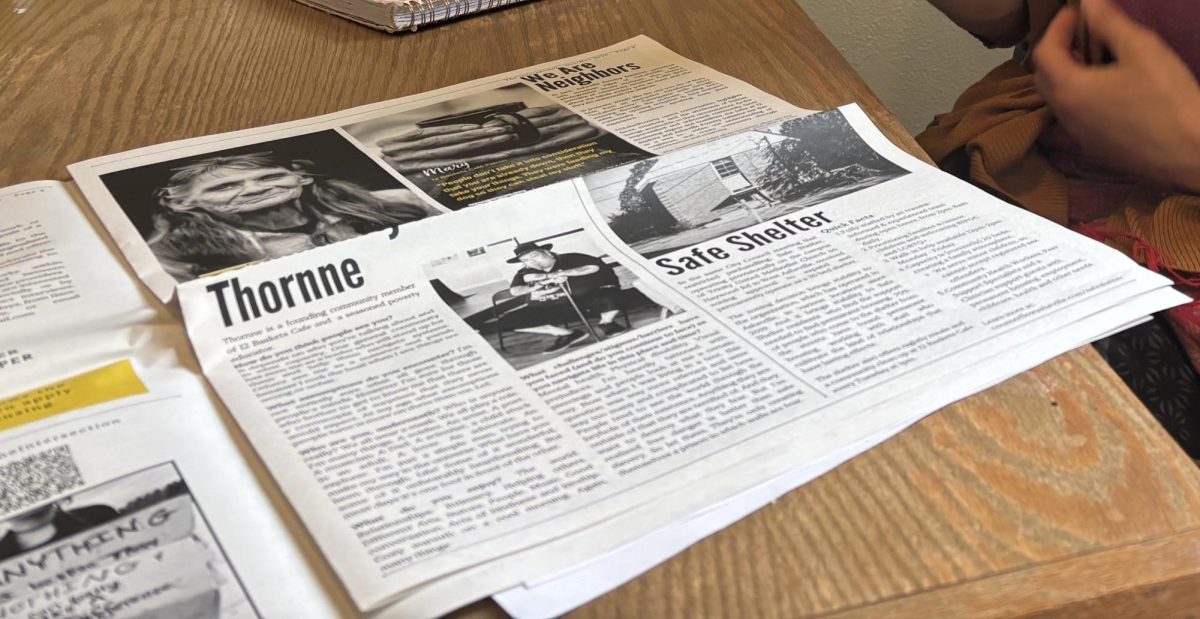
Witherspoon was housed quicker than most after the discovery of a tumor and after undergoing breast cancer treatments in New York, she returned to Asheville and started an internship with the Asheville Poverty Initiative. The initiative operates 12 Baskets Cafe, a free cafe and grocery store for unhoused people.
“We’re open four days a week, (serve) around 200 meals and then around 75 groceries,” Witherspoon said.
Even when securing a space in a shelter, there are still many barriers for someone trying to get back on their feet, whether it be a lack of a reliable phone or the time to get everything someone needs done in the time they’re given.
“A-Hope (Homeward Bound) is only open till 1:00 p.m. So a lot of times when you get there you’re like, okay, do I shower? Do I do my intake? Do I drink coffee? Like, there’s so much to do. Do I use a phone that’s in midst of all these loud people to make an important phone call?” Witherspoon said.
While the scarcity of space within the system for those experiencing need sets up walls, the trauma an individual experiences is another barrier entirely. A study published in the Public Library of Science journal found that an estimated 76.2% of homeless individuals were experiencing mental illness.
“Many of us have had so much trauma. We joke, if you weren’t mentally ill before you became homeless, you are after, just with PTSD,” Witherspoon said. “So many things that never should happen to any human happened to me. It’s a very violent town. It’s beautiful and all, but there’s a lot going on underground, especially because of the tourism industry here.”
Escaping poverty and finding available resources is a task full of barriers.
Once someone finds a soft place to land, whether it’s in a shelter, or in a limited space in a homelessness program, they’re trying to get a job.
“I was a CPS caseworker in 2013. I opened two yoga studios. I taught yoga at university level, I’ve done some pretty amazing things in my life, I was a certified doula. But I went through electroshock therapy and lost pretty much my whole life. My memory prior to 2018,” Witherspoon said.
Living without a home in Asheville comes with unsurvivable temperatures in the winter. 2025 was the first year that Asheville operated an emergency “code purple” shelter throughout the entire winter season.
“This year, we have 40 beds for men, we have 10 emergency beds for women,” Witherspoon said. “There is a larger noticeable population of more men on the street. That’s because more women are hiding.”
Another challenge, according to Witherspoon, is the different rules surrounding each available resource, with many not allowing families to stay together or people to stay with their pets. Some resources will turn people away for their religious beliefs.
“We see the population on the streets pretty much in the deepest part of their addiction. But again, numbers-wise you don’t know how many people. If I’ve been staying somewhere without a lease and I’m behind on my rent, I can’t go to a lot of organizations and ask for help, because they have no record of me,” Witherspoon said.
Witherspoon said that a myriad of things are needed to improve the rising situation. A less disorganized system of resources, more space, more money and more people who cared are good examples to start.
“When I was out on the street, it was a lot easier to forget about my hunger for a day. People will say, ‘there’s so much food, there’s so much help in Asheville,’ but how do I get to that help? How do we actually address the needs?” Witherspoon said.
12 Baskets and the Asheville Poverty Initiative attempt to work with this disorganized system to help those in need find the resources that fit their situations. According to Witherspoon, 12 Baskets aims to sit down with those in need, hear their stories and find out what services can work for them.
“We can push out the panhandlers, but then we’re going to open the doors for more sex work and more theft,” Witherspoon said. “We’ve really just got to speak to each other.”
Mark • Feb 24, 2026 at 8:56 pm
A percentage of tourism dollars should go to housing for homeless!