











The second installment of the “Black in Asheville” docuseries meticulously reconstructs the once tight-knit Black neighborhoods that were razed as part of the largest urban renewal project in the Southeast.
Director Todd Gragg and historian Priscilla Robinson use interviews, extensive archival research and their own lived experiences to great effect. Their work not only informs the audience how Black residents were severed from their communities and shortchanged at every level, but it also moves them toward action.
“Urban Renewal Impact” opens in media res, with the Rev. Martin Luther King Jr. delivering a speech to Black workers in the lead-up to the Poor People’s March on Washington. In the clip, King details the material basis of racism and poverty, explaining how the U.S. government granted millions of acres of land to white people while claiming there was none for newly emancipated Black people. King alludes here to the broken promises of Reconstruction, the “40 acres and a mule” land reform that never came, and the wealth stolen from 400 years of chattel slavery.
“We are coming to get our check,” King said in the clip.
In 1865, after a meeting with Black ministers, Union General William T. Sherman issued a lawful order to redistribute land from former slave owners to freed Black people. However, President Andrew Johnson overturned the order, returning the plantations to wealthy Confederates. A new labor system called sharecropping was instituted, forcing emancipated Black laborers back under the yoke of their former masters. This feudalistic system kept the Black population in the South in abject poverty and near enslavement.
The documentary draws a connection to the 13th Amendment, which made slavery legal as punishment for a crime. Laws that criminalized vagrancy were enforced with long prison sentences. The convict leasing system allowed states to receive payment from private companies for prison labor. Asheville’s own Beaucatcher Tunnel was completed in 1928 by imprisoned Black people. Conditions for Black people in the South kept most on a razor’s edge between low-wage work and prison slavery.
Gragg and Robinson break down other land reforms thoroughly, providing further context for the nation’s continued racial wealth gap. By localizing in Asheville’s Southside and East End neighborhoods before zooming out historically and nationally, the film builds momentum, digging at the roots of what is now known as gentrification.
Urban Renewal was a nationwide program created under the Federal Housing Act that grew from New Dealism. President Franklin D. Roosevelt defended his policies as a way to fight communism and save the capitalist system. The film argues that part of saving the American economic system was maintaining its deeply entrenched racism; one could not continue without the other.
Redlining – the practice of denying loans and development to Black residential areas – became bank policy. Denied infrastructure and investment, segregated urban centers fell into disrepair, providing cover for city governments to apply eminent domain over “blighted” areas. Black-owned homes and businesses were purchased at low prices, sometimes for nothing at all. The promise of quality public housing in new developments, such as Lee-Walker Heights and The Towers, fell short. Left with little money to relocate within the city, Asheville has seen its Black population steadily decrease, from 21% in 1980 to just 12% in 2020.
“Why are Black people in Asheville so angry? And I didn’t have an answer, so I set out to find it,” Robinson says in the documentary.
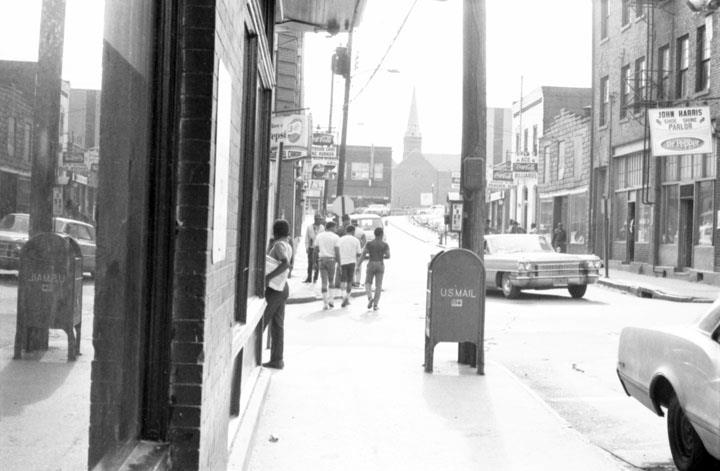
In 2008, Robinson’s preliminary research at the University of North Carolina at Asheville’s archives set her on a path to resurrecting the Black neighborhoods that were targeted by urban renewal – places where she grew up, almost lost to her own memory, came flooding back. Key to Robinson’s reconstruction is the “Black Highlander” collection of more than 1,200 photographs and photos from the Housing Authority of the City of Asheville, as well as the work of the late luminary photographer Andrea Clark, who documented the communities prior to their dismemberment.
“I was like a kid in a candy store,” Robinson says in the film.
Clark’s photos figure prominently throughout the documentary and carry much of its emotional weight. Warm and intimate, Clark’s work is juxtaposed with the clinical distance of the Housing Authority’s survey. Weaving the archival images with Black Ashevilleans recounting the sense of unity that was lost after city officials forcibly uprooted them is gut-wrenching. It is here the film comes closest to answering the question posed to Robinson earlier. A quandary the audience is forced to confront in the present.
After some fumbling with pacing, the editing returns to form, and Gragg runs the numbers. Over 1200 structures were identified as “blighted,” 4000 residents affected, 96% of whom were Black. Businesses, including the first Black-owned hotel, were shuttered, demolished or relocated. Robinson’s research estimates that upwards of $130 million in family wealth was lost.
In the final third, Gragg ingeniously breaks the fourth wall, addressing the audience directly about his direction and the thinking behind the narrative structure. He discusses the books he read to help place the national policies of Housing and Urban Development into the local narrative.
Gragg’s direction sidesteps the trap of creating an 87-minute infographic by following the personal stories of those who experienced “root shock” – the trauma of displacement – and still live in Asheville. They are carriers of history: elder leaders, pastors, mothers, grandmothers and great-grandfathers.
After a screening, J. Hackett, co-owner of cafe GrindAVL – where Robinson’s research is permanently displayed – tearfully asked how not to succumb to darkness. When learning the history of racism and knowing how little has materially changed, how does one keep going?
“I think about our ancestors, and I focus on the work,” Gragg said. “It’s kind of like this idea of giving. If you’re ever in a place where you don’t feel good, the best way to feel better is to do something for someone else.”
It is long past time that reparations were paid — cutting a check is the bare minimum. The work of Gragg and Robinson sheds light on a living injustice, on a promised freedom foreclosed. It is our duty to fight for justice, for freedom, to love each other and support each other. There is nothing to lose but our chains.