



















Alex Chiles, an 18-year old student at the University of North Carolina at Asheville, said he doesn’t feel as if he gets enough nutrition from the limited options offered by on campus dining.
“The food at Brown is buns most of the time and if there aren’t any good protein options that day, you’re basically screwed and starving,” Chiles said.
Chiles said he frequently finds himself eating the same food every day, the ‘Brown Hall staples’ as he entitled them – white rice, unseasoned corn and hotel-style waffles – and he said he’s getting sick of it.
“The other issue I have with Brown is the time frames that they are serving hot food. I have classes until two p.m. on Mondays, Wednesdays and Fridays and they stop serving hot food at two, so I don’t get a hot lunch unless I go to Highsmith,” Chiles said.
Chiles said when he is unable to get hot food at Brown, he goes to Highsmith Student Union to eat, but he is getting sick of eating the same food every time. As a self proclaimed picky eater, he struggles to branch out with the foods he eats and doesn’t find any comfort foods in Highsmith or Brown’s dining options.
Eloise Vaisey, a 19-year-old sophomore studying mass communications at UNCA, also struggles to find food to eat on campus.
Vaisey has celiac disease, an autoimmune disease that affects an estimated 1% of the United States population. It causes damage to the small intestine when the afflicted person eats gluten. Because she has celiac, Vaisey said she has to be very vigilant about what she eats.
“When I toured UNCA they mentioned that they do their best to accommodate gluten-free diets, so while I was worried about cross-contamination, I knew I could make it work,” Vaisey said.
Throughout her almost two years at UNCA, Vaisey said she sometimes struggles with a lack of food options, but has not experienced a flare up from dining on campus.
“The one thing that has been scary is that recently they (Brown Hall) changed the labeling system for foods,” Vaisey said.
With the old labeling system there would be purple signs above each food station that said avoiding gluten and green ones indicating vegetarian or vegan options. According to Vaisey, there were days where these labels were not set out at all and because of that she assumed that none of the food was safe for her to eat that day.
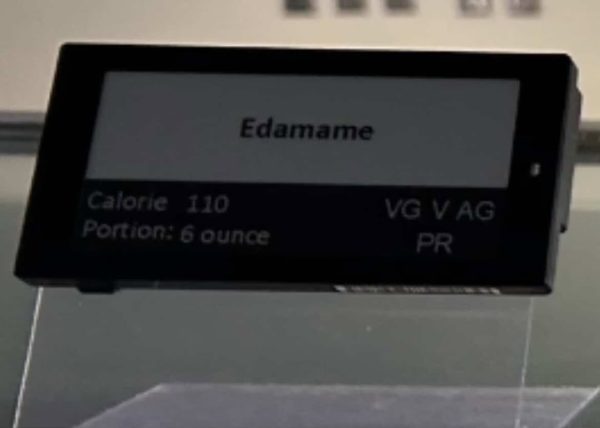
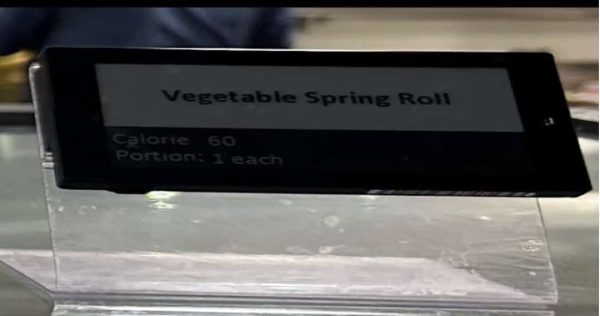
“Anytime I asked they would always solve the problem,” Vaisey said. “It was definitely concerning, though, because some days a food would be labeled as gluten free and other days it wasn’t, so I began to question if it had been mislabeled.”
Vaisey said she always has to be cautious when dining on campus, or anywhere, because with every day comes the possibility a human error could be made.
Henry Baumrind, 18, is a Brown Hall lover and said he is in Brown for an average of sixteen hours a week.
“I love being in Brown! I get to do all of my homework, socialize and study all in one place! Plus, there’s unlimited ice cream and I stay hydrated because I always have some kind of drink at my disposal,” Baumrind said.
Baumrind said Brown Hall does really well at identifying allergens that may be in food, so he and his friend with allergies feel safe eating there, whereas Highsmith dining doesn’t make him feel as safe.
Students join online discourse
On Instagram, there were several accounts created that express the varied opinions of students regarding Brown Hall. The most notable accounts are @brown_hall_neutral, @i.love.brown.dining.hall and @brown_hall_hater, which has recently been deactivated.

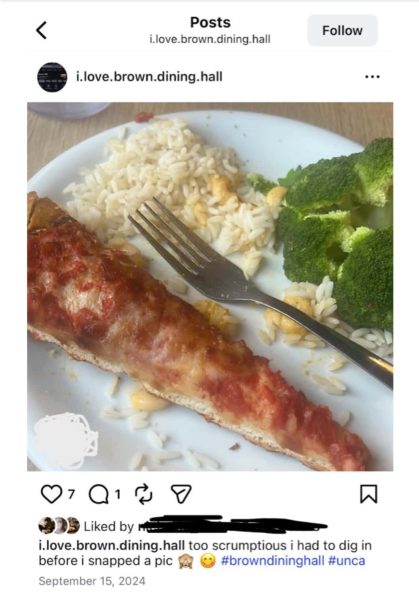
Before its deactivation, @brown_hall_hater was a popular page that took submissions from students, allowing them to express their frustrations with all things Brown Hall. It brought a lot of attention to the dining hall, but not in a good way.
The hate became overwhelming and towards the end, some of the other opinion accounts called @brown_hall_hater out in their bios. For example, @i.love.brown.dining.hall tagged them and said stop hating.
Yik Yak is an anonymous platform like Twitter tailor made for college students. The topic of on-campus dining is frequently discussed there, mostly in a negative light.
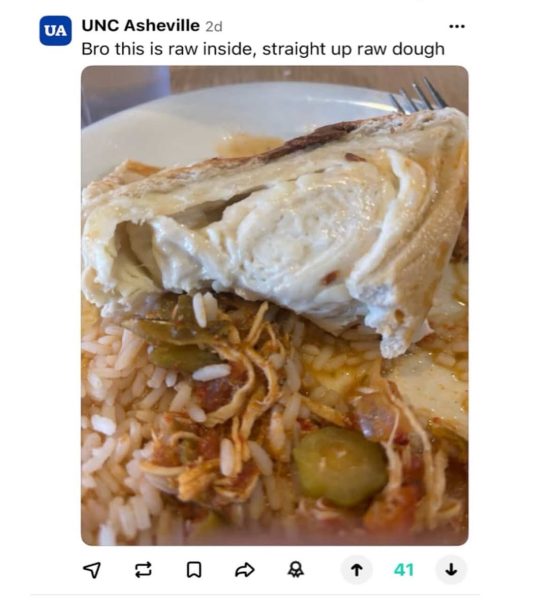
On Reddit, on-campus dining has received mixed opinions from current students and alumni. Most are positive or neutral, with the main complaints centered around odd weekend hours and Brown Hall not having warm food for all the hours they are open.
On TikTok, Brown Hall has received a lot of positive feedback, especially during the aftermath of hurricane Helene. During that time, Brown Hall opened its doors while the rest of the campus was shut down in order to provide food, water and other resources to the community.
Dining management stays vigilant about cross contamination
Jeffrey Sepot manages all things on-campus dining. He began his position at the beginning of the 2025 fall semester and has already gained the appreciation of his entire staff.
Sepot said he and his team are extremely cautious when it comes to cross-contamination.
“To help mitigate cross-contact, all team members complete FARE Check approved food
allergy training twice annually,” Sepot said.
Sepot said most cross-contamination happens from user error due to Brown Hall being an ‘all you can eat’ environment. He said they work to prevent this by doing their best to monitor the self-serve stations and regularly replacing service utensils.
“We use PIDs to identify menu items served on the hot line. The PIDs include icons to
denote if an item is avoiding gluten, vegan, vegetarian or a good source of protein (PR). We employ descriptive recipe naming to help communicate the ingredients in each dish in an enticing way,” Sepot said.
According to Sepot, the term avoiding gluten is used in place of gluten-free. Because the staff works across stations in close proximity to one another, they cannot ensure a 100-percent gluten-free setting.
Sepot said he encourages any guests with questions about food services to speak to the chef or other ingredient experts located in the dining hall or on the second floor of the building.
He said student feedback is of utmost importance to his team and to Chartwells, the food service providers behind every dining option on campus.
“We seek out student feedback using several platforms including annual surveys, social
media, dine with the director tablings and student focus groups. We use this feedback
to build our menus each semester,” Sepot said.
Chartwells Higher Education is a food service providing company that serves 350 campuses across the country, UNCA being one of them. Chartwells’ main focuses are community, sustainability and especially sourcing as much fresh, local food as possible for the campuses it serves.
UNCA’s main food distributors are Sysco and Mountain Foods. Sysco provides grocery and protein items while Mountain Foods provides almost all of the produce. Everything from Mountain foods is locally sourced.