







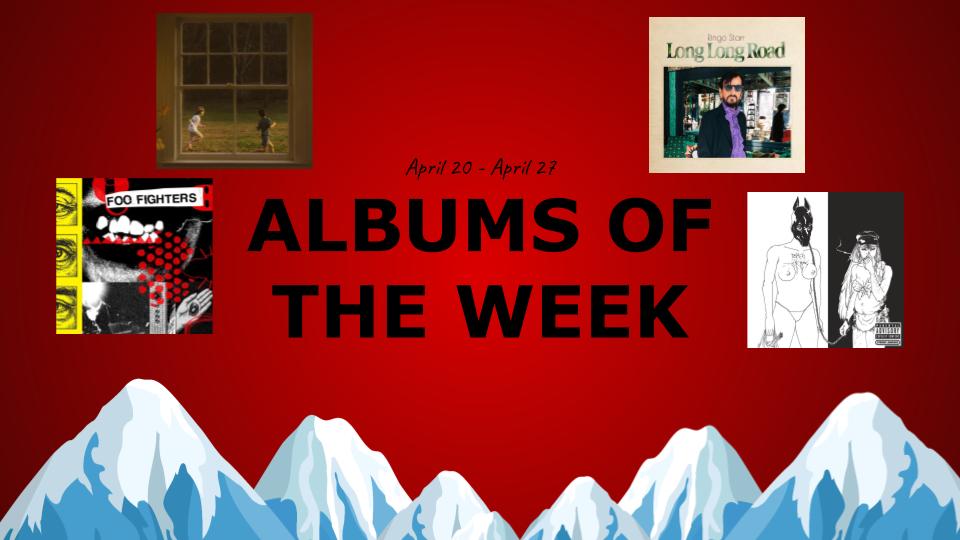




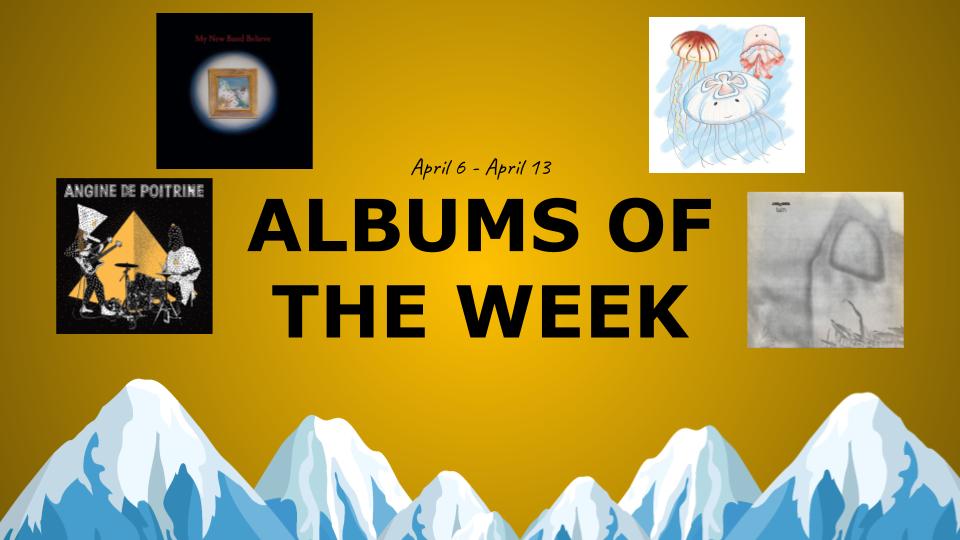
This week, I’ve got another four albums for your listening ears. There will be three new albums from the past week (on a monday to monday basis) and one classic album we’re celebrating the anniversary of.
If there’s an album YOU want to see covered that we missed (or a review that you disagree with) write a review of your own and submit it right here!
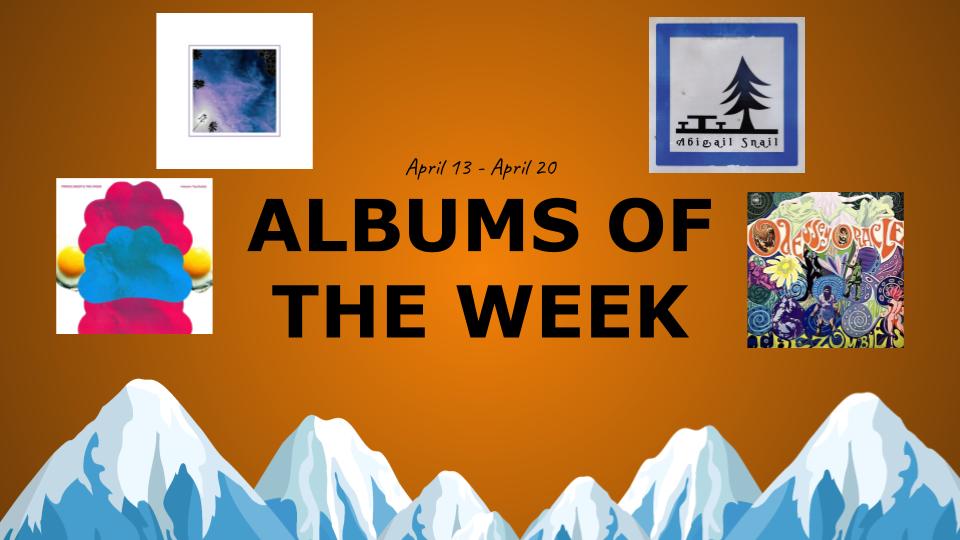
My New Band Believe – My New Band Believe
8.1/10

In my years-long (both professional and hobbyist) career as a music critic, I have always been intensely critical of the Windmill Scene. It’s responsible for some of the best music of the 2020s, but has also spawned countless hollow copycats, in addition to the many slop artists it’s churned out itself. While it’s a scene, not a genre, the music from the little London-based club has slowly been cannibalizing itself since black midi disbanded and “Ants From Up There” by Black Country, New Road released.
Cameron Picton, former bassist of black midi, makes his debut with My New Band Believe. No not my new band, his new band: My New Band Believe. Who’s on first again?
The singles leading up to this record were terrifying. Not in a musical sense, but for what they represented. While “Numerology” was fun, “Lecture 25” was exactly the kind of Windmill-slop that I was worried Picton might have released. Thankfully, that wasn’t the case, and “My New Band Believe” is a wonderful, progressive folk journey marked by hatred through gritted teeth and beautiful guitarisms.
“Target Practice” is our opener and immediately sets the tone. Picton’s vocals are fun, rapidly-changing and theatrical. He has a very unique tone, sort of thin, a bit mousey and undeniably british. This contrasts very well with the softer, acoustic back tracks, featuring gentle guitar and warm strings. The story is also laid out for us. Somebody killed the speaker’s uncle and they want revenge, badly. The refrain of “Don’t cry, you deserve this” is so perfect. It encapsulates the schadenfreude from getting to torture someone who’s done you wrong. Picton’s voice borders on medieval sounding at times and it works great here.
The music swells from here through the next few tracks. Drums are more willing to get wild, Picton gets angrier and the guitar is going a bit further than just chords. “Heart of Darkness” has a moment where the guitar arpeggiates in such a way that it gives one flashes of Nick Drake. That’s of course before it dissolves into a spacious, free-folk, ambient piece for the second half of its roughly eight minute runtime.
Then, it’s time for “Love Story”. Now this is how you write a song. We start with this ominous piano that carries the dark tone over from “Heart of Darkness”, but it slowly moves into major key to transition into the main motif of the song in a gorgeous piano cover. “You are the love of my life, nothing compares to a lonely minute with you,” Picton says. It’s just him and Piano for the first third of the song, before a slow string movement pushes in and gives way for the rest of the ensemble to follow.
The melody is so, so catchy. Each line ends with a simple guitar strum. Just one chord attached to the end of a vocal moment but it’s so gorgeous in its simplicity. I adore it and it keeps repeating throughout the song. After the initial verse from Picton, the music starts to expand a bit more, and we’re left in this baroque space, floating through gentle saxophones and mind-blowingly beautiful strings. He then comes back in, but the energy from the instrumental bridge keeps up.
I’ll say again: this is how you write a song. You get enough of each of the best parts of the song but nothing ever stays too long. This is emphasized by the several seconds of silence at the end of the track; it gives the listener time to sit down and appreciate what they just listened to.
The album goes downhill in quality from here unfortunately, but it never devolves into badness. Just comparatively worse. The story does follow through though, and follows the emotional journey and turmoil that happens through the story. Though it is far more spacey and fragmented compared to the first half where the story is very clear.
I think with a little more interesting movements, a more concise story (which really grips me when it does) and some bolder instrumentation it could be a better piece, but as it is now it’s a really great record. Given that there are many more singles that aren’t on the record, I’m very excited to see where My New Band Believe moves in the future. But seriously: who let him name it that?
Kurage – Mei Semones
6.6/10

Mei Semones debuted last year with “Animaru”, a fun, cutesy chamber pop adventure with a comforting bossa nova and jazz pop influence. While just three tracks long, I’d be remiss not to cover another great outing from the young artist.
The bossa nova influence continues here, with vocal scatting done in tune with bouncy, warm guitar. The plucked strings are all cute and lead into a gentle drumbeat. The warmer guitar and deep strings play nicely with her colder-toned, high-octave voice.
The guitar riffs themselves are really nice. They’re not over-the-top complicated, but there are some nice, more adventurous riffs out there that are good to juxtapose the softer, plain guitar chords. The occasional other instrumentation is also super pleasant. The title track, “Kurage”, has a soft euphonium that sounds just phenomenal with the guitar.
Obviously at only three tracks (which are more-or-less a bit samey) there’s not a huge amount to go over, but I do love what’s here. Hopefully she continues this positive trend and her next full-length LP is just as good.
Vol. II – Angine de Poirtine
6.3/10

Oh boy.
Following a semi-viral performance at KEXP, the Quebecian duo of Khn and Klek (along with producers Tek and Glegg) have blown up, and recently released their second LP “Vol.II”. It’s something alright.
When talking about microtonal math rock, you really have to acknowledge the technical prowess and music theory knowledge that goes into producing such a record. I consider myself a music nerd, and have played in bands with odd time signatures and bizarre instruments. Microtones though are something I’m really not equipped to discuss outside of defining them.
While there’s only 8 defined notes (not counting incidentals) on a scale, each note really has an infinite number of smaller notes between it, less than a half-step before or after a given note. While the music is still coherent, to untrained ears it may sound like a burning carnival.
Like I said, it’s extremely technically impressive. The double-neck bass and guitar combo is really wicked, and operating a pedalboard barefoot (twisting dials with your toes) is incredibly impressive. The drumming is also insane too and oftentimes tracks will feature jumps between multiple time signatures despite the actual lines themselves being more on the simple side.
I do like this record, I really do, but it’s the kind of record you can’t really play on repeat. It loses a lot of its value after the first couple listens when you learn to accept the microtonality. From there, it becomes nothing more than a subpar math record. I don’t hate the tone, but it’s not pleasant enough to be the same for every single track.
A lack of vocals (or rather, a lack of coherent ones) really hurts the record too. A lot of the music feels stale as it goes on (perhaps a symptom of the rather generic guitar and bass tone) and by the end of the record I’m not really impressed with the technicality. Sometimes the characters will make blubbering, muppet-esque noises but they seem stuck in an awkward middle-ground where they’re both trying to play the alien gimmick totally straight, but also want to recognize that it’s funny. The two cancel out and the little vocals that exist are uninteresting despite their nonlexibility.
Faith – The Cure
9.2/10

The Cure’s earlier work is really interesting to look at. You can clearly see them progress away from the post-punkier sound into the more gothic one. “Three Imaginary Boys”, while distinctly different from the rest of their records is still great on its own, and “Boys Don’t Cry” is still one of their biggest hits (despite not being on the actual original record). Their more gothic followup “Seventeen Seconds” was great too. People know the titular “Seventeen Seconds” and of course “The Forest”.
“Faith” however is seemingly ignored on a larger scale. There’s not any hits and it has the misfortune of being stuck right before the comparatively giant “Pornography”, which makes it seem a lot less significant than it really is. The often ignored truth is that this is one of their best records and is filled with classics.
One of The Cure’s best talents is their ability to jump between the upbeat and the downbeat, and the first two tracks on this record “The Holy Hour” and “Primary” are perfect examples of this. The former piece is a slow, dark dance enraptured by thick, squirmy bass, cold guitar and depressing vocals. It’s followed however by “Primary”, which is an upbeat, post-punk adventure about how your life changes following falling in love. It’s totally different from the first track, yet they’re both utterly The Cure.
Despite the quality of the aforementioned “Primary” and others like “Doubt”, it’s the slower ones that really stand out. “All Cats Are Grey” is a slower piece with echoing vocals. Musically there’s not a ton going on other than the ambient drumming and Smith’s depressing vocals. He doesn’t sing that much here either, so you’re left with just the wind-esque, whispering synths.
While this piece surrounds you and drowns you with whispers of a song, it’s followed by “The Funeral Party”, a more aggressive showing of misery. Powerful, synth-strings lead into the track as Robert Smiths goes from a soft whisper to a powerful shout. It’s like he’s trapped in a storm and is shouting out, hoping that somebody will hear him but knowing nobody will. “Two pale figures ache in silence, timeless in the quiet ground, side by side in age and sadness,” is the scene that Smith sees ahead of him.
It’s a great record. While it can be a bit empty at times, it leans more into this side of gothicality than the danceable coldwave that they’d move into with “Pornography”. It’s an important record to analyze when looking at The Cure. While it’s usually skipped over (like I said) it’s worth a listen, and fits a unique mood that many of their other records can’t slot into. While “Disintegration” is a contender for the greatest album of all time, I’ll never stop listening to “Faith”.