











The tea smelled faintly of honey and tasted of honeysuckle. Steam twirled between the bowls, curling into the slow afternoon light that filtered through the tall windows of a century-old classroom on Blannahassett Island in Marshall, North Carolina.
“Take your time,” Shun Yu Huang, 36, the Wu Yong Culture Space founder, gently said, while pouring from a porcelain pot into tiny cups. “Nobody rush here.”
The old schoolhouse, now Marshall High Studios, sits like an island of creation in the middle of the French Broad River, its brick exterior worn from decades of rebirths. Inside, local artists and makers rent studios where brushstrokes mingle through open doors, while in one quiet corner, tea steeps slowly.
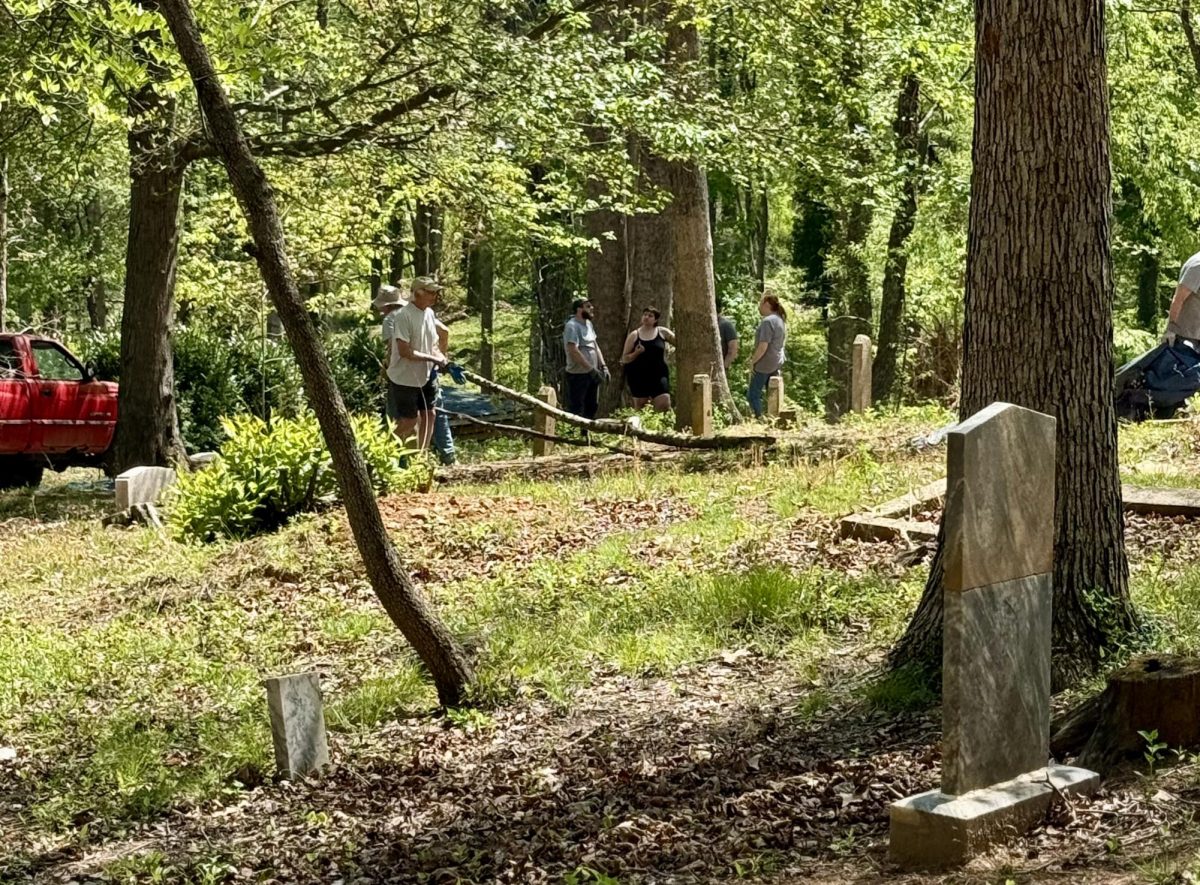
After Hurricane Helene swept through Western North Carolina last fall, volunteers spent weeks repairing the building and hauling debris.
“It’s really a place for artists,” said Anne Rawson, the building’s director. “This building has survived so much, and every time, it becomes something new.”
Same-day volunteer Eli Halpern, 38, a Chicago native, affectionately dubbed the ‘super volunteer,’ was outside, mixing and pouring fresh concrete into the parking lot. He’s been coming every week for months, quietly helping the studios return to life.
Inside, the air was thick with the scent of oolong tea. Huang’s studio, Wú Yǒng Culture Space, a name that translates to useless in Chinese. The irony, she says, is intentional.
“A useless space for necessary things,” Huang said with a soft smile in her eyes.
“I didn’t plan to create a space like this,” Huang said, with a hint of awe. “Even three months before, I had no idea. Everything I do here, storytelling, tea, calligraphy, I’ve been doing for years. I just didn’t have one place to hold it all.”
Now she does. Her corner of the building is part tea house, part classroom and part community sanctuary. Each week, people drift in for Mandarin lessons, writing circles, calligraphy classes and long conversations over steaming pots.
“I use food as a metaphor,” she said. “Because that’s a language everyone can understand.”
Huang grew up in southern China’s Fujian Province, near the sea and hills.
“We’d walk to the water after dinner,” she recalled. “The air smelled like rain and salt.”
Before leaving China, she traveled across her country, from the tropical coasts to the mountainous regions near Tibet, so she could speak of it truthfully, not through the filtered lens of TV or textbooks.
Having lived in Western North Carolina for nine years now, in Marshall, she’s found a new kind of home.
“What I want to do is human connection,” she said simply. “To help people feel more connected to one another, no matter how different.”
That intention is visible in the way she moves with patience, openness and deliberation. During her tea ceremonies, there is no hierarchy, no teacher and student, simply its participants sharing space.
“You infuse the tea many times,” she explained, holding up a cup. “Until it doesn’t taste like tea anymore. Then it becomes medicine for the living.”
For Huang, tea is a bridge between cultures and a reminder of care.
“How we drink or share food is how we do community,” she explained. “Do we pour for others or just for ourselves? That choice is everything.”
Outside, Eli scraped concrete into a smooth line. The tink of the trowel mingled with the rush of the river against the rocks. The restoration effort months after the hurricane had become a ritual of its own.
“He’s our super volunteer,” Rachel Bennett, 34, the volunteer director, laughed. “Its people like him who aided in Marshall being where we are today because of individuals devoting their time,” she said with her hand brushing dust of her thigh as her eyes glimmered with admiration for her community.
The rebirth of Marshall High Studios mirrors Huang’s own journey, as both are acts of quiet resilience.
“Some people see me and wonder, “Why are you here? Do you belong here?” she said. “But I don’t need to argue. I just keep serving tea.”
The name Wú Yǒng reflects Huang’s belief that the most valuable things in life are often the least profitable.
“Not everything beautiful must be useful,” she said, quietly chuckling.
She waves away money from visitors who can’t afford her classes. “You can pay it forward,” she tells them. “Just share kindness elsewhere.”
The walls around her are alive with memory from fabric hand-sewn with her mother, photographs from her travels through China and an old Mongolian poem written in calligraphy that was once gifted to her by a stranger.
“Every item here has a heartbeat,” she said. “They’re not decorations. More so, they’re stories.”
Huang never sought mentors or recognition.
“People say I’m stubborn,” she said. “I just have principles. If I know something is good for my community, I’ll do it.”
She began volunteering at UNC Asheville, teaching language and cultural workshops.
“At first I wasn’t paid,” she said. “I just shared my love. Later, people insisted I be compensated. They saw my value before I did.”
Her young son, Kai, mirrors her openness.
“He says, ‘Mom, you make friends everywhere,’” she laughed. “And now I see him doing the same.”
She demonstrated the Chinese character for his name, which was a blend of heart, valiant and mountain. “That’s what I hope he carries,” she said. “Courage and flow.”
By late afternoon, the tea had cooled to the color of amber glass. Outside, sunlight danced on the water.
“This building used to be a school,” Huang said, looking around. “I like to think I’m bringing it back to its purpose to teach. Just differently.”
Huang set down the teapot, and a soft clink of porcelain echoed against the high ceilings.
“Connection,” Huang said, holding the tiny cup, “must be poured slowly. Shared freely. Sipped until it becomes something deeper than taste.”
Marshall High Studios stands once again as a gathering place for artists, healers, teachers, and wanderers. After the floodwaters receded, it became something more than restored walls. It became a mirror for what’s possible when care replaces speed and art becomes the language through which people rebuild.
And in the corner of it all, Shun Yu Huang keeps pouring tea quietly, redefining what it means to live in community, one cup at a time.
For more information about Marshall High Studios, visit their website: Marshall High Studios
For more information about Shun Yu Huang’s upcoming events, visit her website: Wuyong Culture Space