


















The University of North Carolina at Asheville currently has 45 registered animals, according to the office of accessibility. If you’re looking to add to that number, here is the process:
Registering an ESA and a service animal are very different processes. Once your service animal has gone through all of its training you simply need to let the housing office and office of accessibility know that you will be bringing the animal so that they can ensure your suitemates/roommates will not be affected by it.
Mackenzie Walters, 20, has a service dog named Salem. Salem is three and recently fully completed his task training. He stays with Walters on campus in Founders Hall.
Walters said her experience registering Salem with the school was relatively easy.
“The school was really great at accommodating us,” Walters said. “I just had to go to housing and say ‘hey I have a service animal, this is what he’s task-trained in’ and I had to share with them his health records, then that was it.”
Walters said Salem is allowed in every place on campus that students are, such as in classrooms. She said she has not encountered any issues with Salem being in class with her except for the time one of her teachers was allergic to dogs.
“We just worked around each other, keeping a safe distance,” she said.
The process of registering an ESA is a lot more extensive than that of a service animal.
First, you must have a diagnosed mental or physical disability that requires you to need additional support. Next, you need to have a clinician that you have been working with for over a year. The OA, office of accessibility, describes it as an established, ongoing therapeutic relationship.
The therapists and counselors at the Health and Counseling Center cannot provide this documentation, it needs to be from a provider separate from the university.
Once all of this is in place, your clinician will need to provide documentation (you can find this on the OA website) and then you will need to complete an online application.
After this step is complete, the OA estimates three to five days for review of the documentation. Once it is reviewed and approved, you will schedule a meeting with the OA. They say the wait is on average two weeks.
After this meeting, you will notify housing and residence life of the animal and present them with the animal’s health records. This includes proof of neutering/spaying and the shots they have received. If you have completed all of these steps, congrats! You now have a registered service animal.
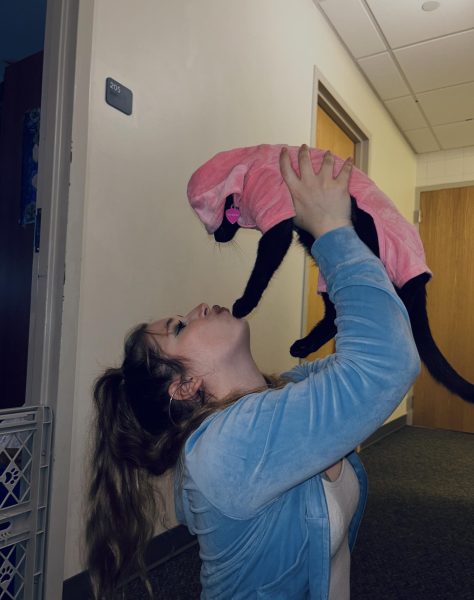
Sofia Vina-Londono, 20, has a registered ESA. Her cat, Georgina. Vina says that the process of getting Gina (Georgina’s lovingly-given nickname) registered took around two, bordering three months.
“It honestly was a little difficult, not because of the woman working there, she’s fantastic, but because it is a one-person department. She had a lot of work only for herself and that made scheduling difficult,” Vina-Londono said.
Aside from that, Vina-Londono said that after getting her documents approved and finally scheduling a meeting with the OA, everything was smooth sailing going forward.