


















Excluding residency halls and parking lots, there are at least 2,581 steps on campus. This is almost certainly an undercount.
1,006 of those steps have some sort of contrast or texture to them. These qualities are not mutually exclusive, not every step that has grip tape has contrast and not every step with contrast has texture.
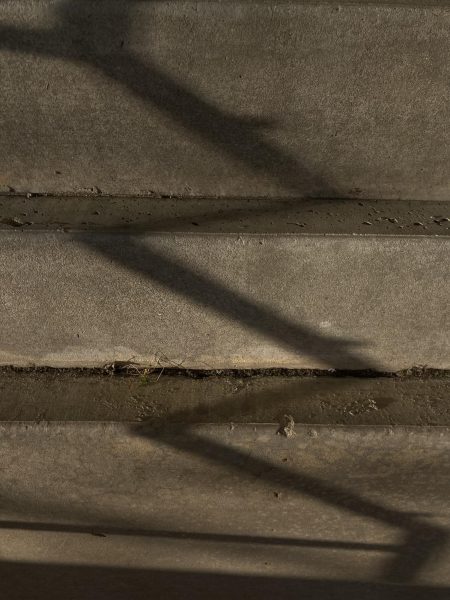
In fact, some steps like how 185 out of 227 steps in Rhodes-Robinson feature a metal plate that provides contrast yet is also slick and smooth even despite the x pattern carved into the step plate. To these steps credit, at least they have contrast.
Almost any contrast provided in this context is a null factor when stairwells across campus (like Rhodes-Robinson) are dark comparatively to others, especially if you have visual impairments. This isn’t to say to make any similar stairwells blaringly bright as that presents its own issues, but the dim and dingy lighting is not entirely adequate.
This leaves 1,575 steps without any high contrast, easily visible, textured tape. Why is this an issue?
During my saunter I almost fell by the steps near Ponder and found the Kimmel arena close to wiping me out as well. The Americans with Disabilities Act requires at least COF .6 on flat surfaces and COF .8 on ramps- this means a high friction surface.
As a publicly funded institution, UNCA has to follow the ADA.
This is especially ironic with the consideration of certain premises, like the aforementioned Rhodes-Robinson, having incredibly slick surfaces as a constructional feature.
When looking at Karpen (whose only elevator remains broken at severe inconvenience to people with ambulatory issues despite the outside ramps) we can find a series of flights of stairs with a single grip strip at the top and bottom of each flight. This is still useful but it does heavily cut down on the total number of campus steps with grip tape.
Let’s break down the 1,006 steps.
Whitesides has 100 steps with high contrast but no grip. Delany has 67 high contrast steps with no grip. Rhodes-Robinson’s slick steps have some contrast but they’re hard to tell with visual difficulties.
I could not access Lipinsky as it was thoroughly locked due to renovations.
Karpen heavily pads our 1,006 figure with 225 steps, however 200 of those steps exist within several top and bottom strips of some flights of stairs along with having a flight of stairs that features 25 continuous steps with contrasting grip tape. Additionally, as trivial as it may seem, the pattern of that staircase of 25 makes the tape blend in, reducing its contrast ability.
Philips features all of its 41 interior steps with high contrast grip tape (with 14 additional steps outside that have contrast but are slick).
Highsmith has 127 treadplate steps, but no contrast and 53 additional steps with no contrast or grip.
The Sherril center and Kimmel arena features 178 high contrasting grip steps out of its total 707.
Zaiger has 21 steps with a rubberized tread plate but has absolutely no contrast.
Zeis and Owen have no ADA compliant steps. Furthermore, Owen has 11 exposed I beams that are grey against a grey background. These can be extremely dangerous with their exposed edge and deceptively still nature.
I understand that my data collection may be flawed, both in the precision of my final step count as well as my subjective assessment of how well the steps may contrast.
I recommend a black and yellow friction tape bordered with a reflective tape on every single step edge for the simplicity of replacement and assuredness of fresh friction (it may help to have a routine replacement of this tape).
Along with that, dangerous vertical angles (like I beams or the vending machine in Whitesides I thumped my noggin on) should be decorated with a highly visible motíf to reduce injurious occurrences.
The university disputes the requirements of grip tape, citing OSHA guidelines not requiring grip tape but instead recommending them, thus skirting the grip tape regulations:
“The Occupational Safety and Health Administration recommends that walking surfaces have a static coefficient of friction of 0.5. A research project sponsored by the Architectural and Transportation Barriers Compliance Board (Access Board) conducted tests with persons with disabilities and concluded that a higher coefficient of friction was needed by such persons. A static coefficient of friction of 0.6 is recommended for accessible routes and 0.8 for ramps.”
From university officials:
“Since these are recommendations and not requirements, UNC Asheville is in compliance.”
This however is contradictory to th U.S Access board:
“Accessible surfaces must be slip resistant to minimize hazards to people with disabilities, especially those who are ambulatory or semi-ambulatory or who use canes, crutches, and other walking aids. However, the standards do not specify a minimum level of slip resistance (coefficient of friction) because a consensus method for rating slip resistance remains elusive. While different measurement devices and protocols have been developed over the years for use in the laboratory or the field, a widely accepted method has not emerged. Since rating systems are unique to the test method, specific levels of slip resistance can only be meaningfully specified according to a particular measurement protocol. Some flooring products are labeled with a slip resistance rating based on a laboratory test procedure. Compliance with the standards requires specifying surface materials, textures, or finishes that prevent or minimize slipperiness under the conditions likely to be found on the surface. Standard practices for minimizing floor or ground slipperiness will likely satisfy compliance with the standards as slip resistance is important not just for accessibility but for general safety as well. Applications and finishes used to increase a surface material’s slip resistance may require continued maintenance or re-application.”
When asked for a more accurate step count the university replied:
“We do not have a total step count for all University stairs. A good amount of time would be needed to provide that information.”
Why does this matter? aside from complying to the legalities of the ADA as a publicly funded institution and reducing chances of injury for all, it is an extremely simple fix and cheap procedure, especially with the consideration of the financial and labour resources to be devoted to a daydream of a soccer park at the expense of our forest when far more grounded issues need to be stepped on first.
