











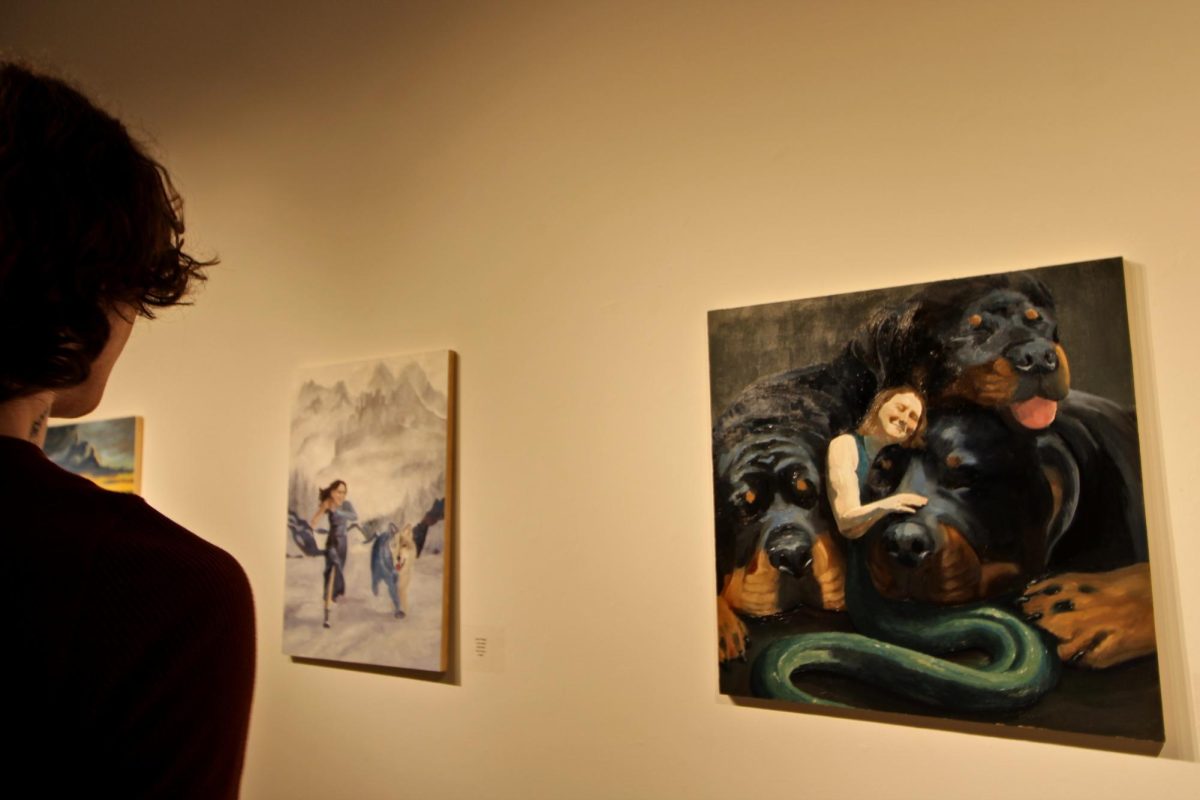
There’s one painting that people linger in front of longer than the others.
In heavy shadow and sharp light, the painting’s technical dramatics evoke chiaroscuro, but its focal point resists the tension being built—a contented woman, smiling, embracing a huge three-headed creature that should terrify. You step closer, then back—try to understand what you’re seeing.
At the entrance of the S. Tucker Cooke Gallery in Owen Hall, a large statement on the wall gives a clue. Throughout much of European mythology, it reads, women are often cast as villains—figures like Medusa, remembered less as characters and more as obstacles for male heroes to overcome.
UNCA senior Liam Cheng’s BFA exhibition, “Monstrous Feminine,” perches itself in that tension, reimagining these so-called “monstrous” women as nuanced—and even tender—figures.
“I’ve always loved drawing and painting—and just making art around women,” Cheng says.
Their interest has taken many different forms over the years. As a kid, it showed up in their drawings of princesses, princes and bugs—whatever caught their attention at the time. However, Cheng always felt a pull towards the fantastical—toward witches, creatures and characters that exist just outside the bounds of normalcy.
“I’ve always been a Halloween person. I was a ‘Monster High’ kid. Witchy, sorcery, all that stuff—I love it.”
In college, that aesthetic curiosity developed into something more intentional. In Painting IV, a course where students are encouraged to begin forming a thematic foundation for their work, Cheng returned to mythological female characters they’d felt drawn to in the past.
“The start of my paintings was just drawing monstrous women from different myths who I thought were cool and that I really enjoyed. Like the Baba Yaga and Medusa—just strange, witchy characters—because I’ve always loved them,” they say.
Their visual interest developed into a deeper investigation—one that would come to shape ‘Monstrous Feminine.’
“A lot of the research came in the past year for this exhibition. As much as I loved mythological women, I didn’t know a lot—it was more of a casual knowledge that I picked up from pop culture, quotes I read, or witnessing those characters in a story that someone adapted,” Cheng says.
In their artist statement, Cheng points to a pattern embedded throughout mythology—while male monsters exist, women are disproportionately cast as villains, their stories often reduced to the roles they play in elevating male heroes. These narratives, shaped by patriarchal systems, have carried into modern culture, reinforcing the idea that femininity is to be feared or controlled.
Cheng’s work pushes against this tradition. In their paintings, these female figures are reframed not as obstacles but as glorious subjects in their own right—expressive and fully realized.
“I present them as content and joyful,” Cheng writes. “As a form of protest against not only their demonization but also the depreciation of femininity as a whole.”
The presentation is personal, as Cheng describes their relationship with femininity as tumultuous.
“A combination of my childhood and my relation to monsters and women—also my strange relationship with femininity and what it means to be a person who was a woman at birth—all those things contributed,” they say.
Through the process of reimagining these figures and, in some cases, modeling them from the people they love and even themself, they began to see it differently.
“In celebrating my loved ones’ femininity through painting,” they write, “I have learned to love mine as well.”
This emotional undercurrent grounds their work in reality, even as the subject matter leans toward the mystical.
During this process, Cheng learned to balance instinct and intention. They tell me they’ve always loved capturing the human figure—faces, expressions, the physicality of a body—but building worlds around those figures didn’t always come as easily.
“I struggled a lot with what to put in the background of my pieces at first, because my priority is the figure,” they say, with a shrug. “But you don’t get better at something by ignoring it, so I really tried to develop the skill of interesting backgrounds that not only complement the figure in the front but also bring more story, more nuance to the piece.”
Cheng cites John William Waterhouse as an inspiration, admiring his technical precision and the richness of his work while also staying critical of how women are portrayed within it.
“Even though I don’t approve of his use of models all the time and he was also questionably weird when it came to ‘exotic-looking’ things, like lots of orientalism and his fixation with the Middle East—even with all that, he painted a lot of the same things that I’m interested in and I really admire his technical skill,” Cheng says.
The duality of their admiration paired with critique mirrors the approach Cheng takes with their own work.
“I’m proud of my art,” Cheng says. “I think I’m a good artist. Of course, I have a long way to go with the things that I want to create, but I think that the things that I can make are really cool.”
Confidence didn’t come without reflection. Over the past four years, Cheng tells me, they’ve grown not only as an artist but also as a person—learning how to care for themself, how to navigate relationships and how to hold both pride and humility at the same time.
“I’m proud of myself in the way that I know how to take care of myself—I know how to listen to myself. I’ve been growing so much over the years,” they say. “Socially, mentally—I am not the same person I was fouryears ago.”
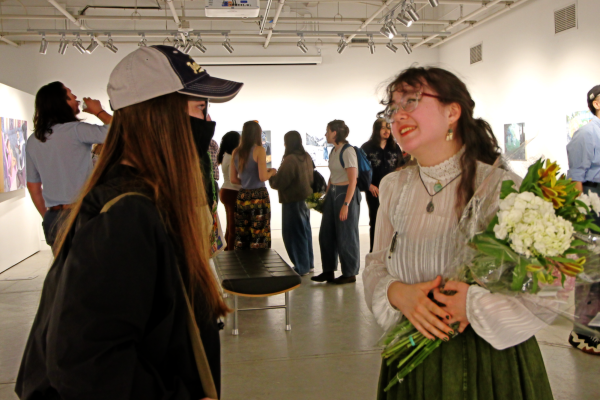
Back in the gallery, audience members circulate, stop and react. Some linger for a while, while others move quickly and then double back. Among those viewers is Eli Green, Cheng’s oldest friend, seeing the work in full for the first time.
“This is fucking insane,” Green says. “This is the second time I’m going through—I definitely had to go through twice because the first time I was just fighting back tears.”
They’ve known Cheng since the fifth grade, long before “Monstrous Feminine” took shape.
“It’s so insane seeing Liam’s evolution,” Green says. “They’ve always been drawing and doing art and stuff, but obviously when you’re in the fifth grade, it’s just like, ‘Oh, I’m going to draw this anime character.’ But this is something else—it’s so, so impressive.”
Cheng’s voice softens as they describe their friendship.
“I’m so happy that Eli’s able to come to my show and that they are still in my life. If anything bad happens in my life, I know that they will be there. I could go, ‘Hey, let’s go move to some obscure country,’ and they’d be like, ‘Okay, let’s go,’” Cheng says.
When asked what they want to be remembered for, Cheng offers a simple response.
“I mean, nothing lasts forever and nobody’s going to be remembered for, like, forever,” they say. “But I think that emotion is remembered the most.”
For Cheng, that’s what matters—more than the myths, more than the monsters.
“How I make people feel,” they say, “is how I want to be remembered.”