


















Are McDonald’s french fries a musical instrument? Are guitar strings protein-packed? Do colors make sound? Is I-26 part of nature? Was Bach a comedian? ChatGPT, write an article using close-cropped and blurry photographs:
“I was really happy about it. It seemed like the audience was very baffled, very confused about it,” said Harrison Bell, ensemble member and UNCA student.
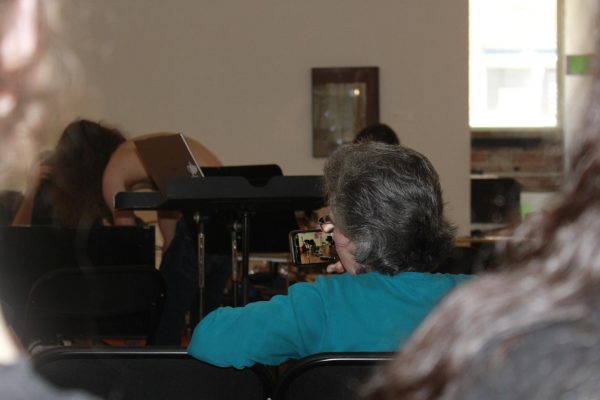
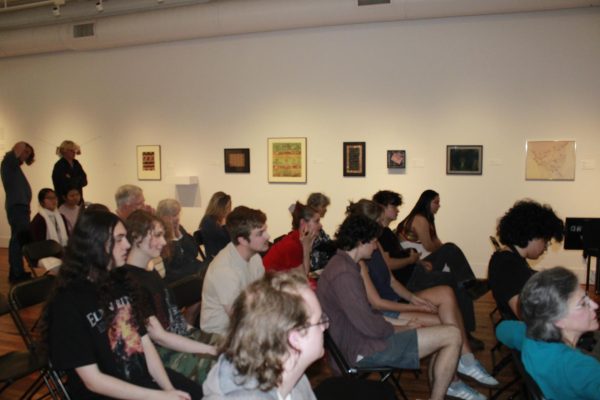
Bell, as conductor, directed the audience to laugh hysterically at excerpts from “Goldberg Variations,” one of Johanna Sebastian Bach’s most tender and renowned compositions. Performances of Western classical music are often sacrosanct, stuffy and steeped in bourgeois decorum. Bell’s intention of unmooring the expectations of the audience to be silent and appreciate – through laughter – makes a lighthearted examination of these tropes. Many in the audience – a split mix of young and old – shuffled in their seats, wrinkled brows and darted eyes around the main gallery of Black Mountain College Museum. The choir snickered, guffawed and giggled. At times, the chortling chorus expressed genuine amusement at the Bach composition and possibly at themselves.
“I think I performed pretty well,” said one chortle choir member, James Lynn.
“A lot of them seemed uncomfortable, and seemed like they were wondering, ‘Why is this happening, what’s wrong,’ which was kind of the goal,” said Bell.
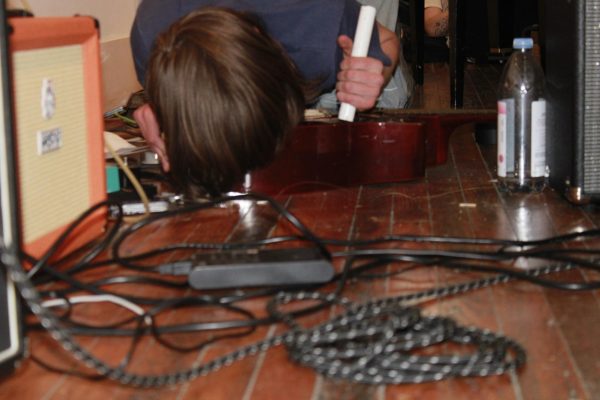
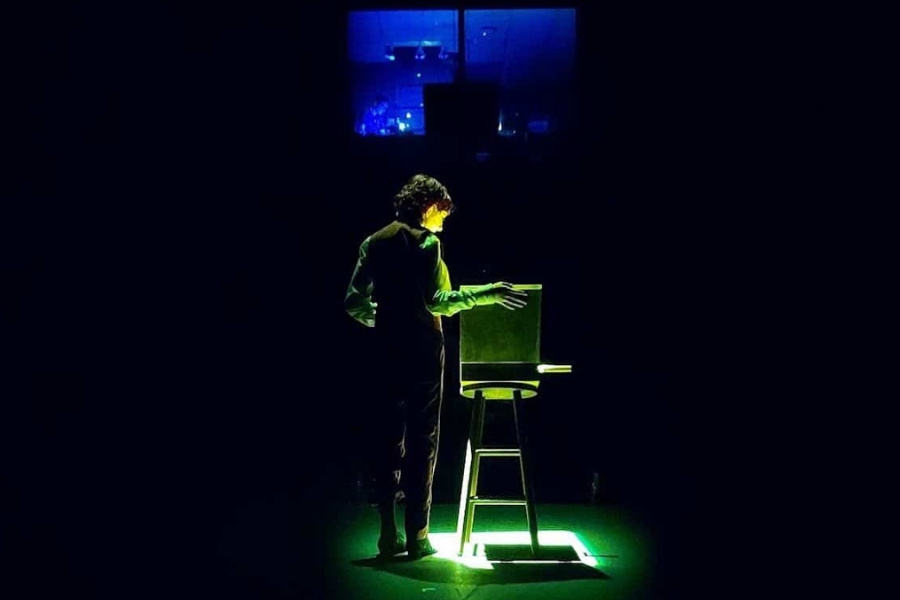
Leslie Buddy performed the piece “Noise” with her hands and ankles bound. Writhing on the ground and apropos of the name – she played guitar with teeth, tools and tenacity. In an effort to break free from her constraints, Buddy gnawed and smashed the guitar entirely. Her review of the audience’s performance was equally biting.
“It’s so fun. I wasn’t really paying attention to the audience,” said Buddy.

“Butoh” by Nathan Evans engages a question that the poet Goethe might have pondered: Do colors make sound? A video by fellow ensemble member Sean Young was projected on the white museum wall behind Evans. Butoh dancers in monochromatic costumes conjured slow fluid movements, as if they were clouds shifting shape. Evans created a program that took numerical data from colors in the video and turned it into a compositional midi piece. The result is a performance where no one performed, no music was played by a human but it was a live production. Notes linger and pop in discord. A low-frequency hum similar to the sound of an MRI machine plays throughout the eight-minute soundscape. In the realm of deep-listening compositions by Pauline Oliveros or a David Lynch film, “Butoh” is at play with a subconscious terror and glee.
“I think the audience did great. I heard someone walked out, I hope it wasn’t because they didn’t like it,” said Evans.

Another piece recreates an experience akin to walking into Brown at lunchtime. RJ H.’s “University of North Carolina at Asheville” involved the ensemble’s members milling around, eating McDonald’s and playing chess. Snippets of overheard conversations wove together on such topics as police violence, surveillance, indigenous land rights, housing, the food at Brown, who’s dating whom, and the use of artificial intelligence in the classroom. As the din of intermingling campus talk turned tacit, two performers were left in a heated discussion.
“Why are you using AI?”
“Why shouldn’t I?”
“You’re an artist, a creative.”
“The artist is the listener, the perceiver, what’s creation?”
“You shouldn’t have a computer tell you, figure that out for yourself, you create meaning, you’re
human.”
“What about the trees, the birds, they create. Are you ok with that?”
“Yeah.”
“OK, let’s keep it there.”


Every member is given an opportunity to expand on the motif of the ensemble. This edition is an ecological approach to music. For UNCA biology student Garrett Davidson, that meant recreating and reinterpreting what encompasses “natural” sounds of Appalachia. In “Nature” tree frogs croak with a low bit-rate, decaying crickets chireep with enveloping delay, and the natural world expands beyond the tree line when an air-braking truck barrels through the idyllic soundscape. A question is posed to the listener about what constitutes natural and unnatural, and whether I-26 is as bad as everyone says it is. It is.
Bryce Hall led a rough-cut of his work “Human/Machine” that involves a complex use of every available time signature. Moving from polka to Guaraldi, the ecological element of intercourse between silence and sound – an ecosystem of music – came through.
“I think the audience did great. I think we have different levels of music capabilities, cause no one has to be a musician to be in this ensemble, so mine was a little rough. But everyone should come out to see it done better on April 21 on the Quad,” Hall said.
The show was fun, it was eclectic, it questions and attempts at questioning answers and even offers answers that question questions. Highly recommended for those who believe music is simply whatever you care for it to be.