





















Feral ponies exhibiting abnormal behaviors in Grayson Highlands State Park appear to be an increasing concern among hikers.
Scattered throughout the terrain, these ponies have been an ecological solution relocated here in 1974 by the Forest Service to control an overgrowth of bushes and grass along the Bald Mountains.
Once domesticated horses have been released back into the wild, they become feral due to a behavioral regression. The current Highlands ponies are descendants of 50 Assateague domesticated ponies, with only between 100 and 150 ponies allowed to be retained in small herds, according to the Wilburn Ridge Pony Association.
The Wilburn Ridge Pony Association said, “an annual auction is held when the ponies start to overpopulate the terrain, with proceeds exceeding $500,000, allowing ongoing support of the park and its preservation, while also funding two local fire departments.”
Frequent hiker Bronte Mensah-Hayden says the best place to see the ponies in their natural habitat lies between Massie Gap and Wilburn Ridge, which is along the Appalachian Trail. A frequent spot for grazing ponies through the grassy balds and alpine meadows, where an open terrain lies waiting for hikers to both rest and take in the scenery.
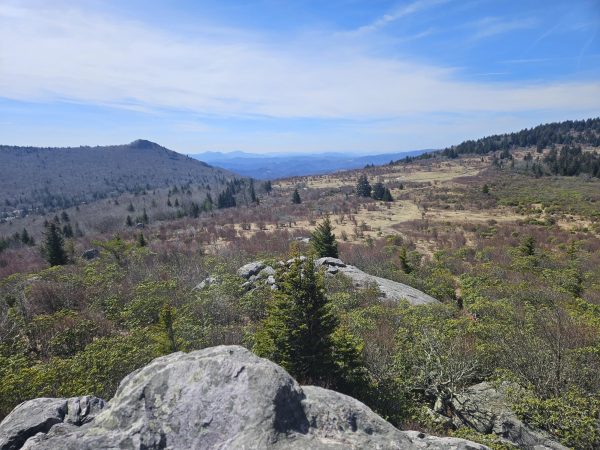
Becoming an attraction for the last 60 years to tourists and locals alike, these ponies are the main or only reason some come to visit the Southwest of Virginia, according yo Brontë Mensah-Hayden
“I grew up in the very small county of Chilhowie and this park is probably the only reason I still come back,” Mensah-Hayden said. “The only thing that irks me is when people don’t think the park’s rules apply to them.”
The state park’s rules can be found on both their website and on signs posted at the trailheads: Don’t touch the ponies. Keep your distance andmost importantly, don’t feed them.
According to EQUUS, The Horseowner’s Resource, unlike humans and many other mammals, horses cannot vomit because of their equine anatomy. The esophagus acts like a one-way valve, adding to their weak diaphragm and inability to consume certain foods.
Horses do not have the ability to digest meat, dairy, or processed foods, which can lead to several health problems. Pre-packed foods can contain hidden ingredients that can be harmful, such as artificial sweeteners, preservatives, additives and high levels of sugar or salt, EQUUS said.
According to EQUUS, these ingredients are the bulk of hikers’ snack staples, and if fed to these ponies, it can cause devastating consequences. Even domesticated horses need to be gradually introduced to new food over a long period of time, only with a veterinarian consultant.
Witnessing people crossing these boundaries, despite posted signs, has become the reason the natural behavior of these feral ponies has drastically changed throughout the years, according to Mensah-Hayden.
A group of people took these rules as suggestions when they directly approached two grazing ponies and without taking precautions or considerations, abruptly petted them and combed their fingers through their manes with food as persuasion, Mensah-Hayden said.
A board-certified veterinary pathologist, Dr. Madison Richard, conducted a series of experiments and research on the integral differences and similarities in the behavior of wild, feral and domesticated horses.
“The consequences of unusual behaviors are based on introducing domestication to feral and wild horses while letting domesticated horses roam wild,” Richard said. “The process of domestication introduced new challenges to the horse, including restricted movement, changes in diet and reduced social interaction.”
Despite these ponies exhibiting a range of behavioral differences, some are too trusting and take the initiative when interacting with humans, said Jae Wells-Bristol, Mensah-Hayden’s partner.
According to Wells-Bristol, their group of friends were talking amongst themselves when a white and brown pony strolled right up to them, startling everyone with this interaction.
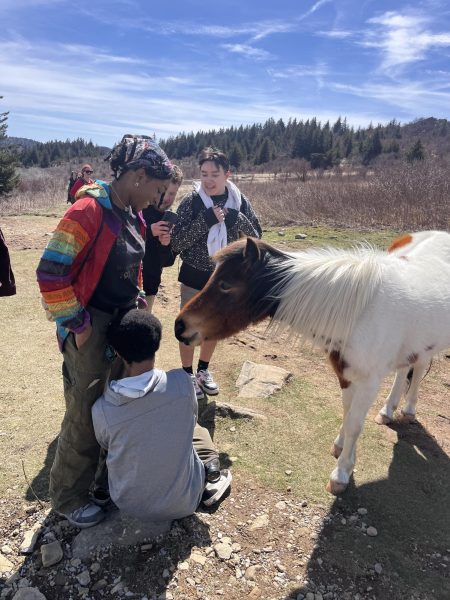
“We stood still like statues, and I was half squatting trying to get up from the ground, not knowing what to do,” said Wells-Bristol.
“He touched me, he put his nose and mouth on my cheek and even went to nibble on my hair,” Wells-Bristol said. “I was actively fighting the urge to stand up and run away, but I didn’t know how he would react to sudden movements.”
“He sniffed all over me for food. I can’t imagine how many people have actually fed him so much that he’s comfortable enough to come up to me,” they said.
Wells-Bristol said that despite being afraid, they will treasure this moment for a very long time.
“It definitely makes me want to come back. This time, I’ll probably double-check for any snacks in my pockets.”