
























Animals on campus at UNC Asheville have become an everyday occurrence; both students and faculty feel it’s for good reason.
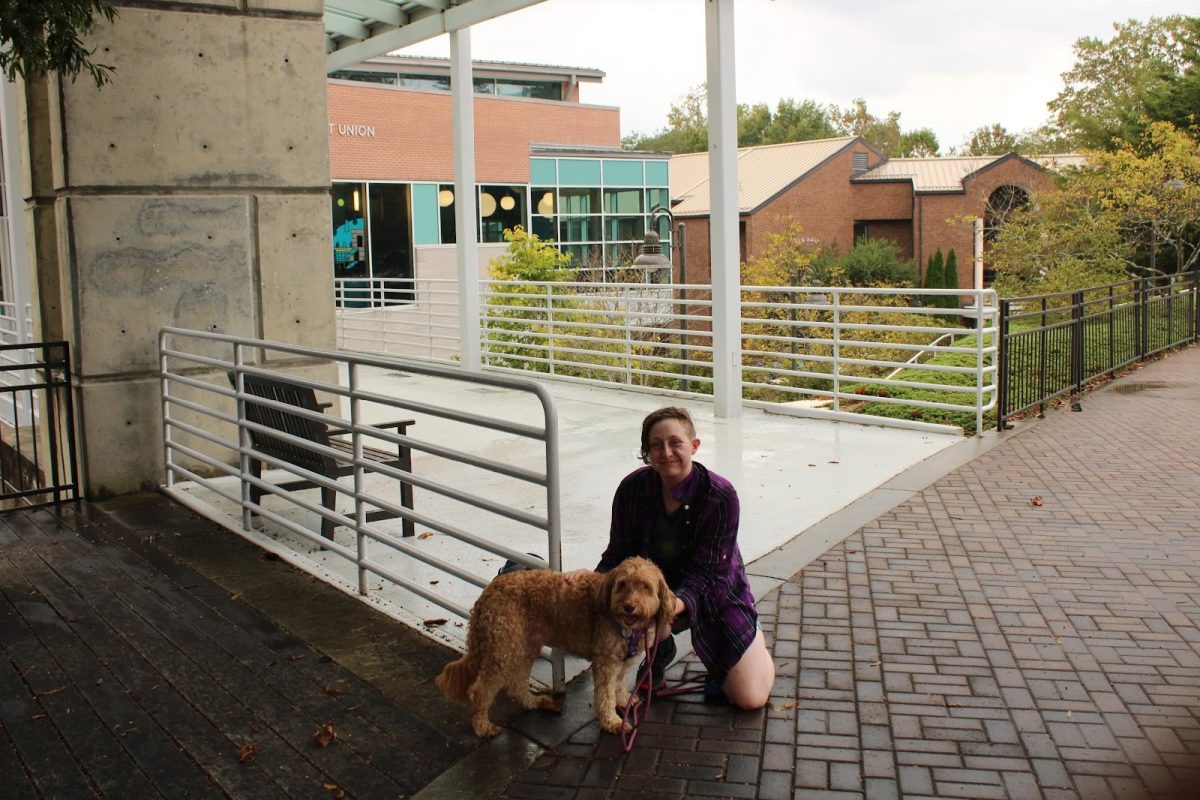
“Trixie is one of my favorite people, even though she’s not a person. She is the one who got me through some very rough years. The start of freshman year of high school, my dad passed away, so it was not a great start to my high school career. Having Trixie there beside me, like I said, she’s the reason why I would get up in the morning. She was the reason why I would go outside, not just sit in the dark all day,” said Alex Cooke, a 22-year-old student living on campus with an emotional support animal named Trixie.
Cooke says that their dog Trixie is more than just a pet. Trixie helps Cooke deal with their mental health problems.
“Trixie is always there when I need her. I had a rough time in high school, so having Trixie there with me made it a whole lot better. She helps a lot with my depression, because she’s a dog. She needs to go out and she needs to be fed. Having that routine and a reason to get out of bed really helped,” said Cooke.
Because Trixie needs to exercise, taking her for walks and to play at the campus’s designated pet areas gives Cooke opportunities to socialize with fellow students.
“Trixie helps me a lot with being social,” said Cooke.
According to Cooke, the process of registering her emotional support animal with the campus was not difficult.
“Not as much as I thought there would be. To get an ESA approved you have to be established with the disability services on campus, and they send a questionnaire to either a doctor or mental health professional that you’ve seen. Once you give them that information and you fill out information on the type of animal you’re bringing, then if you do get all of that you do an interview with someone from the office and they’ll go over all of your accommodations,” said Cooke
The director of residence life at UNC Asheville, Dylan Lawing, works closely with his team to help students who live on campus receive any accommodations they may need, including emotional support animals.
“There’s what are called ‘service animals’ and those are protected by the federal government. They don’t technically have to, if they have a service animal, report or let us know that they are a service animal, according to the federal government. We love for them to let us know that there is an animal in the space, but they don’t have to do that. Then there are what you call ESAs or emotional support animals, those are protected under the fair housing act; those get approved through the office of accessibility. Both of those are present here on campus. We have to be able to allow ESAs based on that fair housing act, that’s kind of a guideline we have to follow,” said Lawing.
Lawings top priority is to make students feel comfortable and at home.
“Our goal is to essentially ensure that all residents that live here in our residence halls feel like they belong, they have comfort, choice and feel that they want to be here. Feel that this is their space, and it feels comfortable and like a home for them while they’re here at UNC Asheville,” said Lawing
There are only a few things that will prevent a student from living on campus with their emotional support animal.
“Is it a community disturbance? That’s a thing we have to weigh a lot of the times when it comes to animals on campus,” “It’s balancing the needs and benefits of an individual student and the community,” said Lawing
Support animals are very common on campus, but at one time the sight of one was somewhat rare.
“Maybe mid-way through my career, so maybe let’s say six or seven years ago, it was memorable to encounter one. Now it just feels like an everyday experience, a part of being on campus,” said Evan Gurney. “I don’t have a memory of any emotional support animals in my classroom, but I encounter them all the time, of course, on campus. In the halls, and on the quad; all over the place,” said Evan Gurney, an English professor who has taught at UNCA for more than a decade.
Gurney says that the rise in support animals is indicative of either a rise in mental health issues as a whole or a rise in understanding and honesty surrounding the subject. Either way, helping solve issues pertaining to mental health is good.
“It seems like, it appears like students struggle more with their emotional and mental health more than maybe they used to, for a range of factors that I don’t know. That, or students are, in a very healthy way, more honest about things. So, what maybe a student would have to experience in isolation, nowadays for a range of reasons they might feel comfortable sharing,” said Gurney.