













The lights at Little Jumbo glow softly, gilding the edges of everything in the narrow bar. Conversations linger as a saxophone, sighing in relief, airs into a melody. Bass, guitar and drums fall in after, and what begins as a melody dissolves into something wilder.
The quartet, officially called Sanders, Boyd, Page and Hall, plays on Tuesdays at Asheville bar Little Jumbo. The bar has regularly hosted live music since 2019 and exists as a hub for the local jazz scene. Even if you don’t personally ‘get’ jazz, it’s found quite an audience in Asheville.
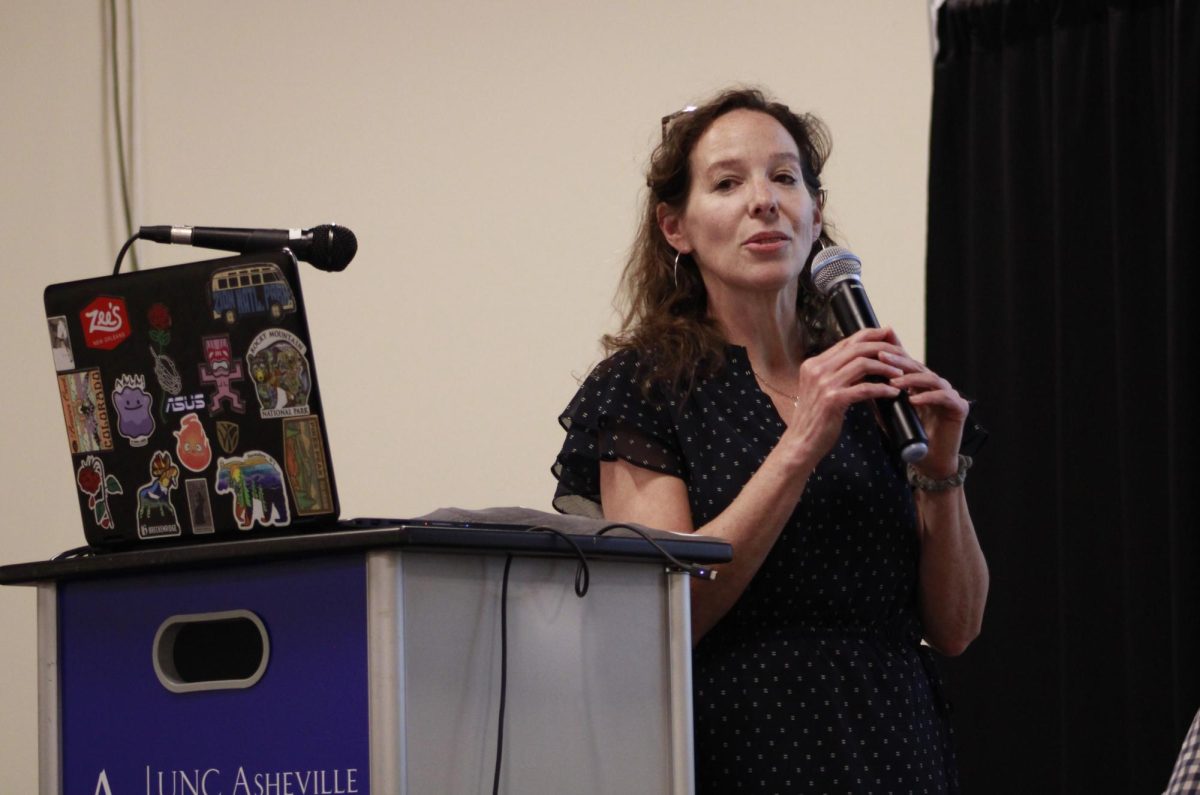
According to Jay Sanders, leader of the band and co-owner of Little Jumbo, the music gives people a way to emotionally connect in the wake of Hurricane Helene and COVID-19.
“People are craving real connection and real experience because we’re all overwhelmed,” Sanders says.
A significant portion of music listeners in America don’t listen to jazz. The complicated nature of the genre can make it seem inaccessible if you haven’t had a lot of experience with it.
“I view it as American classical music,” Sanders says. “At its truest form, it’s complicated. It’s difficult. It can be challenging as a listener and as a performer.”
Sanders says the complexity is what makes it vital. Jazz serves as a reflection of the contradictions that make up American life.
“The word ‘jazz’ is a very complicated one,” Sanders says. “It represents 120 years of American history and art. It encapsulates racism, and it encapsulates gentrification. It encapsulates everything great and everything bad in the American story. It’s all there inside this one cultural identity.”
Due to how expansive jazz is as a genre, in style and in cultural influence, it can be difficult to pin down what exactly jazz is supposed to be. Some listeners are turned off by that ambiguity, but Sanders says he sees the fluidity of the genre as an opportunity to experiment with new sounds.
According to Sanders’ website, mindtonic.org, “Sanders, Boyd, Page, and Hall serve as an ongoing canvas of like-minded sonic adventurers.”
Their sets arabesque into jazz, rock, blues, metal, African influences and bursts of improvisation, blurring the line between control and chaos.
Sometimes the quartet opens their set with “August 8th,” a sprawling, jammy tune that features a catchy melody, building into a rhythmic swirl spinning off in all directions before finding its way home. It’s music that’s discovering itself as it goes, and that’s the point.
“At its core, jazz is about improvisation,” Sanders says. “Improvisation, at its core, is about emotional expression in the moment. In order to experience it, you have to be present in that time. Whether it’s recorded or in-person, it only exists while it’s being made.”
On a Tuesday night at Little Jumbo, the room is busy. There’s nowhere left to sit, so you stand. There’s a tiny but robust music setup at the front of the bar. People are drinking, merry. Some people are standing up against the wall, shoulder to shoulder. Everyone’s so close that you can’t help but think of the times when you were forced to be so far apart. A bass is warming up in the corner.
Zack Page, bassist for the quartet and music educator at UNC Asheville, says that the appeal of jazz is how it’s different every time.
“There’s one thing about going to see a band that’s going to play a song the same way and nail it, but it’s cool to see the other side where it’s going to be completely different,” Page says.
Watching Sanders, Boyd, Page and Hall, their solos melt into a back-and-forth conversation and connection between the players.
“Sometimes cool stuff happens, sometimes it doesn’t. But it’s cool to see people going for it. Like Will Boyd (reed player for the quartet), he’s such a reserved person, but once he gets that horn in his mouth, he just really comes alive. And I think a lot of musicians are like that,” Page says.
After Hurricane Helene in 2024, the community’s need for connection was greater than ever, Sanders says.
“We tried to open as soon as we could after the storm,” he says.
Little Jumbo reopened in early October 2024.
“The reason we did that was because we knew that the community needed a place to come and gather, some place where it’s normal,” Sanders says.
Little Jumbo is decorated eclectically. When you’re not mesmerized by Will Boyd on alto saxophone, you’re admiring how awesome the ambience of the place is. The lights are remarkably gold-toned, giving your surroundings a warm hue. It’s a friendly establishment where you can get a beer for 3 dollars.
“One of my favorite things about Little Jumbo is that I see everybody there. And that means more to me than almost everything else that I do,” Sanders says.
It makes him emotional because Asheville is significantly affected by de facto residential and economic segregation, he says.
“We live in a small community, and I’m just filled with joy whenever I see all races, all socioeconomic groups, all ages there. It just makes me happy, because music really is transcendental,” Sanders says.
Even if you aren’t yet a jazz listener, there is room for you at Little Jumbo. Jazz nights on Mondays and Tuesdays are free to attend.
“There’s no exclusivity thing, like when there’s a good jazz band playing at a restaurant but the entrees are 50 bucks. It’s not cost-prohibitive,” Page says.
Sanders intends to keep the establishment as accessible as possible. He says his main goal as both an artist and co-owner of the bar is to bring together his community.
“We try to keep it all super accessible. It doesn’t have to be expensive to be good. Everybody deserves the good things. It’s not just for the affluent,” Sanders says.
According to Sanders, “There’s that Harvard Happiness Study. That’s a result of generations of research, all saying that the one thing that makes people happy is connecting with other people. So don’t create barriers. That’s why we do it the way that we do it.”
To anyone who says they don’t ‘get’ jazz, Sanders offers an invitation instead of a defense— “You just haven’t found the part that speaks to you.”