















UNC Asheville junior Mikaela Futrell balances directing and producing a play with a packed schedule of campus leadership roles—returning to theatre on her own terms.
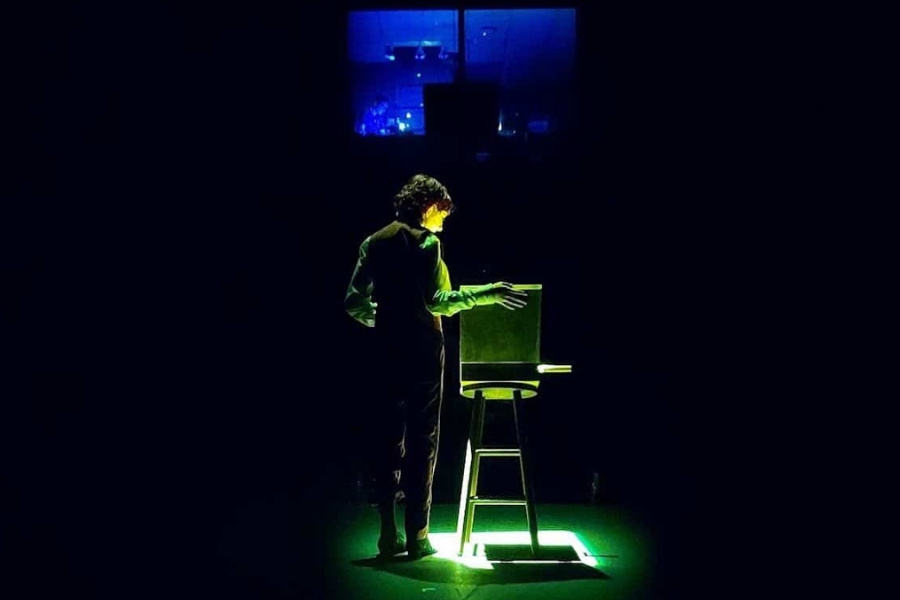
We meet up at her apartment to discuss the upcoming production she’s putting on at Attic Salt Theater, opening in less than a month—“Happy Days,” the acclaimed existential tragicomedy written by Samuel Beckett. The production runs April 10-12, 2026.
Many people who recognize Futrell’s face know her from her involvement on campus. You’ve certainly seen her around—maybe pushing a cart heavy with canned produce up to the quad, where she often tables with Food Equity Initiative as one of their co-directors. The on-campus organization combats food inequality through food drive campaigns and regular, free food distributions.
Futrell leads me to her room. She leaves a perfumed trail fluttering in my face as I follow her down the narrow hallway—frankincense and myrrh, certainly, as well as some kind of sweet floral.
Maybe you know Futrell as an RA in your building. Or perhaps, in freshman years of yore, you had her as your orientation leader—this year marks her third year returning to the gig. Her previous hard work in the role got her a promotion with a cushy title: Futrell now works as a community coordinator for Student Engagement.
“So outside of all the stuff I do for orientation and FEI, I also plan non-traditional student events—events for first-gen, transfers, stuff like that,” she says.
Futrell herself is a first-gen college student. She applied to six schools, all in-state, and got into all of them. She chose UNC Asheville—without having toured the campus or city—because the institution had offered her the most financial aid, and she’s paying for college with her own money.
We sit on the floor next to her bed, on a red woven rug. Behind her, a shelf stuffed with vinyl records sits, a small black turntable on top, the overflow of her collection leaning neatly against the shelf.
You could also possibly recognize Futrell from class. She majors in drama with K-12 teaching licensure and hopes to become a high school theatre educator. She graduates in 2027 as one of UNCA’s last theatre majors, due to the institution’s decision to curtail the program (along with three others) in response to a $6 million budget deficit.
“I love theatre, I love live stuff. I think that goes along with how I also prefer physical media, how I collect records and DVDs, stuff like that.”
The walls in Futrell’s room are one big, floor-to-ceiling collage, a testament to everything Futrell loves: notes from friends and mentors, poems ripped from notebooks, and endless music posters, many from record sleeves, plastered to the wall. The Cure. Alice in Chains. Joy Division. Title Fight.
“My earliest memory of theatre—I saw a play in elementary school. It was ‘If You Give a Mouse a Cookie,’ the theatrical version, you know? And I just thought it was so cool that the book I loved so much in class was right in front of me, happening,” Futrell grins.
She didn’t always want to work in theatre. Originally, she wanted to work in forensics.
“I was a STEM kid, hardcore. I was in the forensics club starting when I was 11. I did AP chemistry and AP forensics—I loved it a lot!” Futrell exclaimed, an old excitement still in her pale green eyes.
However, she had an experience in her junior year of high school that ignited her true passion.
“My theatre teacher asked me to mentor the freshman theatre class. And that did something for me,” she says. “She talked to me after class one day and said, ‘You really have a gift for teaching and theatre. I would hate to see that go to waste if you went into STEM.’”
We hear a voice in the hall. One of her roommates just came home—we hear the front door open and click shut, followed by the familiar sounds of someone in the kitchen.
“When it comes to theatre, it’s not something that feels like work to me. I don’t struggle in any aspects of it—even if I’m doing tech stuff for the first time, it’s just my thing. It’s my butter and my jam, you know what I mean?” she says.
I’m sure it’s not all been easy, I tell her. Over her shoulder, a familiar Labi Siffre record stares from the shelf.
No, it hasn’t always been easy, she admits. Futrell traces her finger on the rug’s ornate design.
“There was a time last year, my sophomore year, when I was crying at work because I was so overworked and so overwhelmed,” Futrell says. “Spring semester, so literally a year ago.”
She had been working an internship at Different Strokes! Performing Arts Collective and tells me that at age 19, she was the youngest intern they’d ever had.
“I was working on three shows that semester alone. I’d worked on seven shows in those two semesters—so there were only two weeks at a time when I wasn’t actively working on a show,” Futrell says.
It was a great honor and opportunity, she says. In fact, landing that role is what she’s proudest of so far. But on top of her other obligations, it was too much.
“I’d just be so exhausted. I was also student teaching and working to prepare for orientation—I sat in on so many orientation assistant interviews. If there was any time I had a gap in class, I was working an interview,” she sighs. “Or prepping for rehearsal that night so that I didn’t look like an idiot in front of my cast without anything to say.”
A day came when Futrell realized she needed to take a breather.
“One of my bosses at Student Engagement, Abby—there was one day when I came in to work and she pulled me into her office and was like, ‘I have never seen you so dim.’ Then she sent me home. She told me to go take a nap.”
So Futrell did that. The next day, she asked her professor, Aaron Snook, for guidance because he works with her boss at Different Strokes! often.
“I told him that I was getting all these pieces, all this work, often last minute. I have a really hard time saying no to things,” Futrell says, nodding. “And because I wasn’t saying no, my boss—rightfully so—assumed that I could do it.”
Futrell gets a bit emotional for a moment. She tells me that after deliberating for a bit and talking to some mentor figures, she got the guts to call her boss for a chat.
“We met up. I said I was going to pause on theatre stuff,” Futrell says.
She pauses.
“And then I took a five-month break from it.”
The break gave her clarity. Futrell focused on other pursuits: student teaching and on-campus involvement. She leaned into her work with FEI as it moved into its new space, The Side Door, located under Highsmith Student Union (formerly The Bike Shop). She applied and became an RA.
Even with a break from her passion, she hasn’t been going in circles. The soft skills she’s practicing in her jobs enrich her abilities as a director.
“I think my biggest example is RA stuff. In theatre, directors mediate all the time. I’m like a therapist in a way. I’m filtering their emotions, and I’m nitpicking things that they don’t even realize that they’re doing, you know what I mean?” she says.
It’s very easy to imagine Futrell mediating a tiff between two residents the same way she would approach a scene between two actors—using a comforting amount of empathy yet an assertive, honest voice to navigate the intentions of everyone involved.
“I think the biggest part of directing that I love is figuring people out and guiding them—in a way that makes them feel like they did it on their own,” Futrell says.
She adjusts her glasses.
“And with FEI, I’m guiding people to feel more comfortable taking food without them even realizing it.”
My first proper interaction with Futrell was last summer, at an FEI food distribution. In the July heat, she sat at the clothed table, in the shade of a tree, shadows of leaves making wobbly shapes on her face.
“Sometimes people will come to our distributions and go, ‘Oh, no, someone’s going to need this more than I am,'” she says, shaking her head. “I’ll respond, ‘Well, food is a human right—everyone needs food,’ very casually, almost like it’s a joke. Until it clicks for them.”
And that’s exactly what she had said when I first got to know her, at that FEI distribution last July. Yes, it did indeed click—I gratefully walked home with a few pantry staples I’d needed as well as a feeling of security. Perhaps other students can offer similar stories.
Now, after taking a healthy break, Futrell’s putting her director hat back on. She says that her professor, Aaron Snook, recommended “Happy Days” to her. Futrell says she picked the show because she found its style intriguing and the characters’ struggles relatable.
“I’ve just never understood how someone could stick by something so hard when it’s killing them,” Futrell says.
“Happy Days,” first performed in 1961, centers on a woman buried in a mound of Earth at the waist. Her largely silent and unresponsive husband lives behind the mound.
“The main thing I thought when I read it was, ‘Why do they stay?’ Why don’t they dig her out? Why doesn’t she get out? He could leave at any point. Why is he staying?” she muses.
The play explores complacency, isolation, and marriage—all themes of evergreen relevance, fertile for exploration.
“It’s the same reason I loved ‘Waiting for Godot’ so much. The characters could take things into their own hands, but they just don’t do it. They don’t,” Futrell adds.
Futrell says she finds the play’s message still relevant today despite debuting over 50 years ago.
“I feel that a lot of people just kind of lie down when it comes to their lives, and I wish that people would allow themselves to think creatively and outside of the box.”
Indeed, Futrell sticks to her own words. She tells me about her ultimate life dream: going to school at Northwestern in Chicago, getting her MFA in directing, and opening her own nonprofit theater.
It’s ambitious, of course, but Futrell speaks spiritedly. It’s easy to imagine her dream coming true, knowing her work ethic.
“I want to work with people who impress me 24/7 and challenge me, not just fluff my ego. And we can do cool shit,” she laughs. “That’s my dream. And be a professor on the side.”
With “Happy Days,” Futrell is already making that first part a reality. She cast UNCA students and friends Sara Nussair and Susana Hudson as the main characters Winnie and Willie, respectively.
Futrell got to know Hudson in a directing class they took together last year after realizing they both had similar approaches to theatre.
“We would both come in on workshop days, and we would think the same way and have the same taste in shows,” Futrell says. “I was talking to my professor about it, and he said, ‘You should work with her.’ I said, ‘I want to.’”
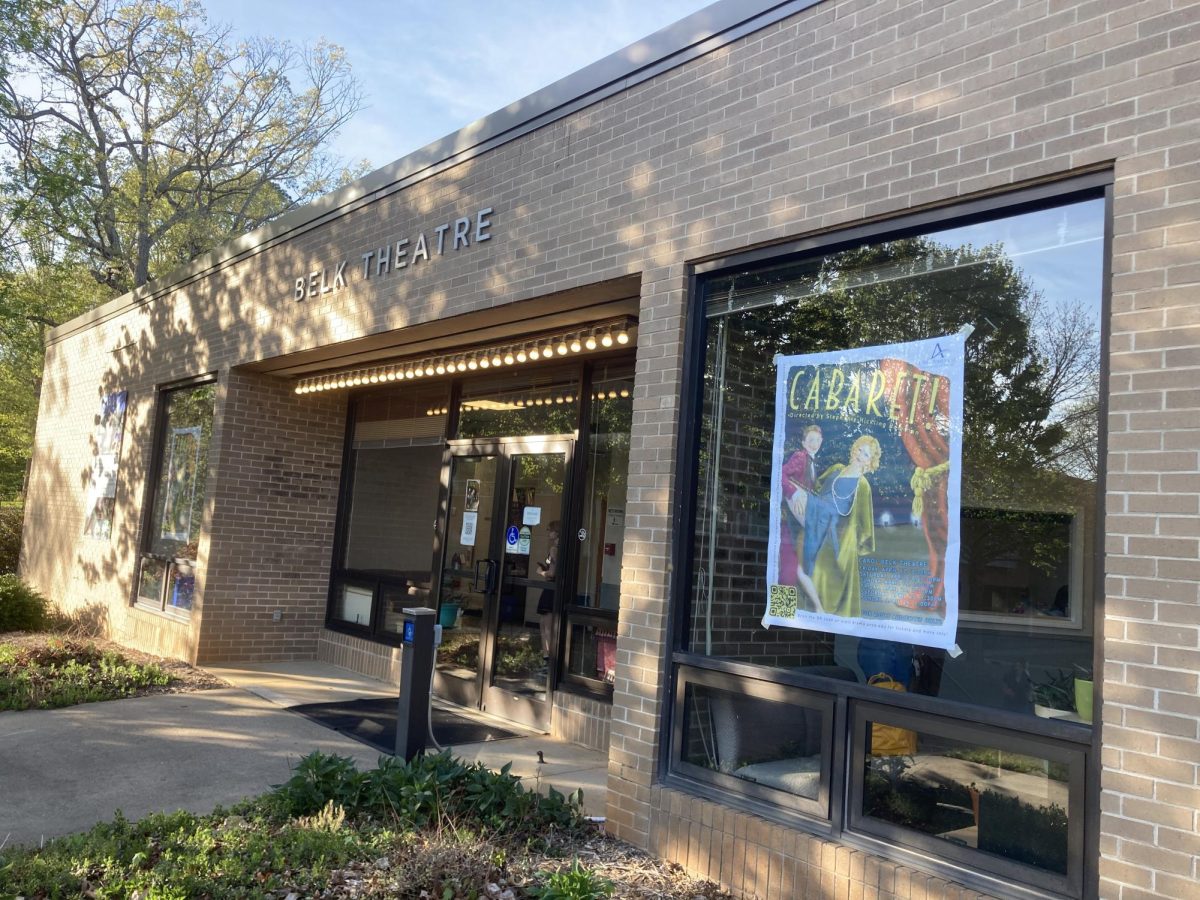
Futrell then performed in “The Cabaret,” a production Hudson directed last year with UNCA’s drama club.
“Working on that with her, it was like we were speaking the same language—which I find very rare,” she says.
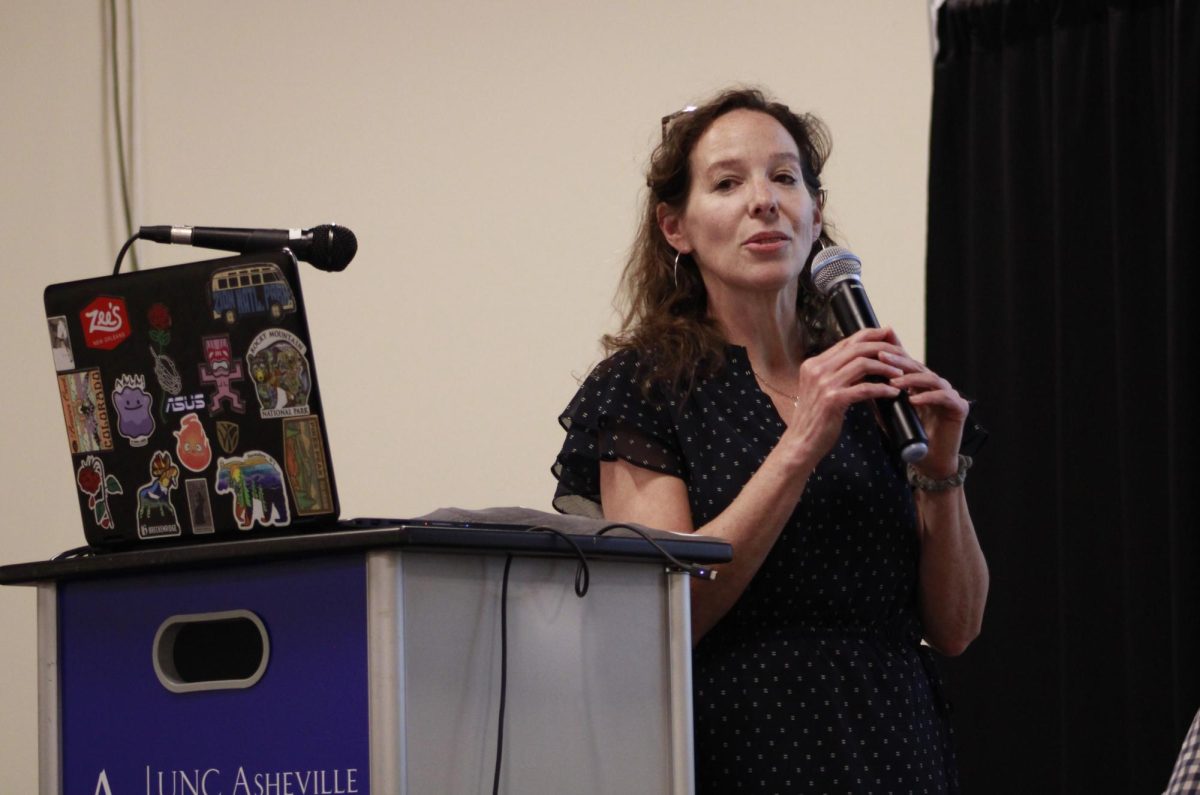
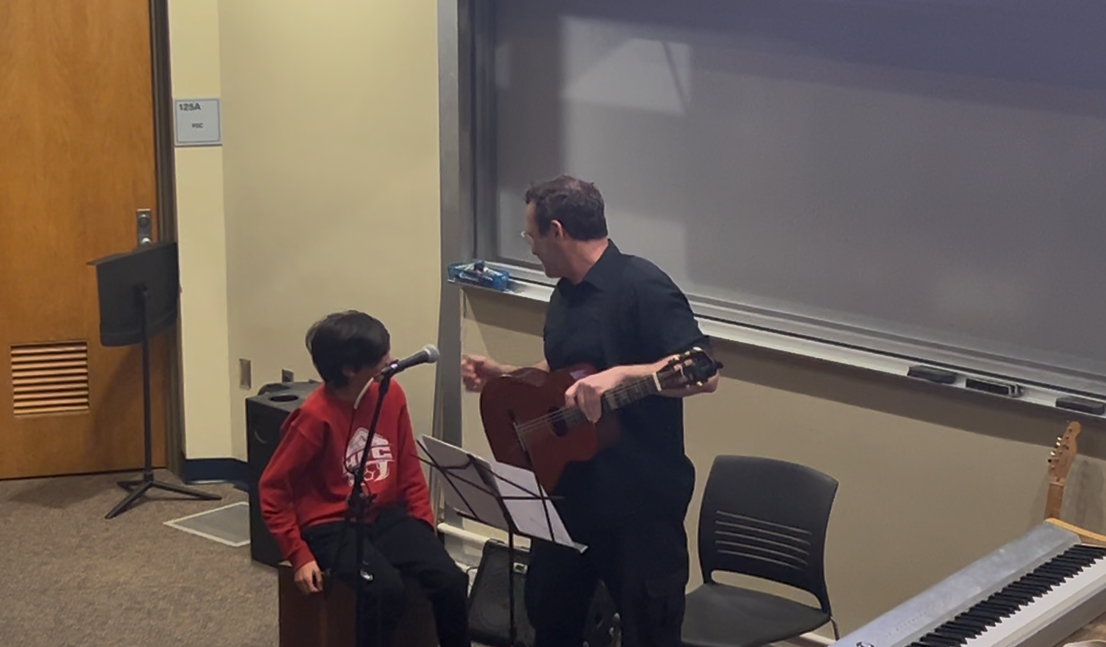
When Futrell directs, she speaks in metaphors a lot. She also goes to rehearsal with a notebook and pencil, not a script. After the interview in her room, we walk to one of these rehearsals.
Futrell and her cast stand in the lobby of Whitesides Hall upon realizing that their rehearsal space, which Futrell technically has booked, is occupied.
“There’s been a scheduling mistake, I guess. ‘Cabaret’ is in there,” Futrell says, gesturing to the room.
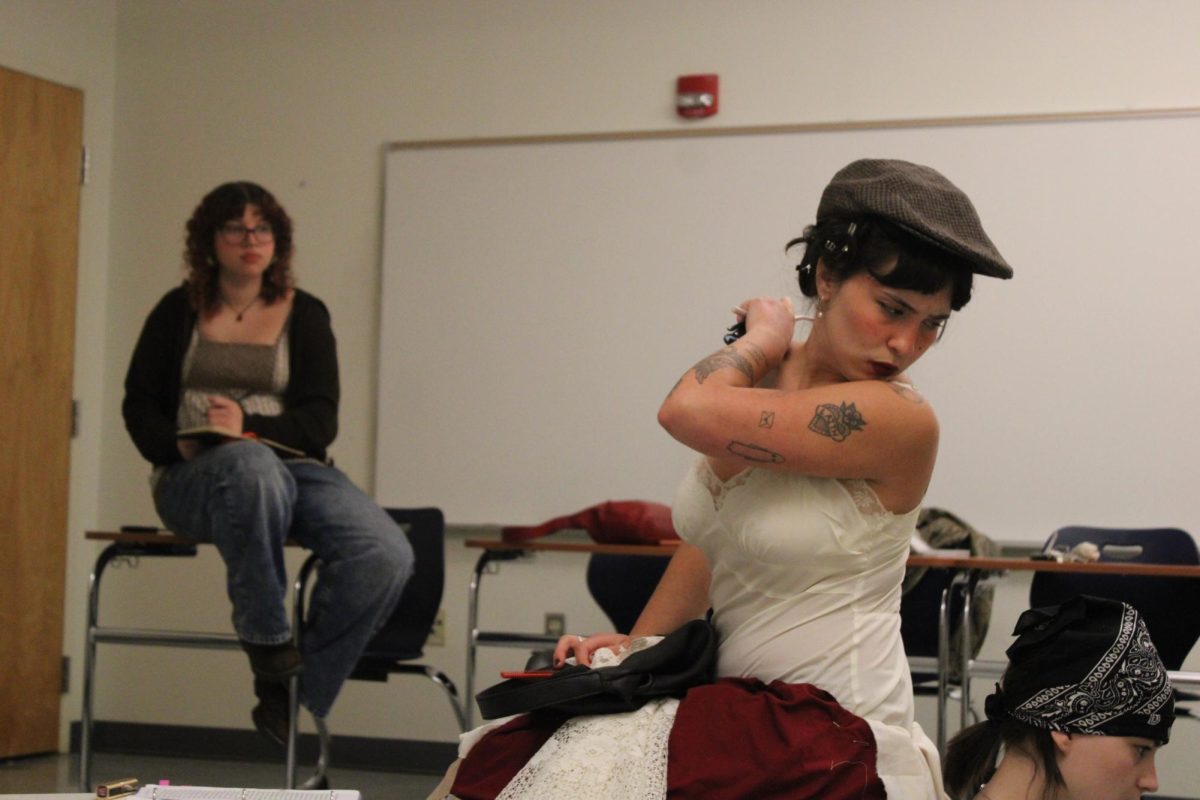
After verbally airing out their frustrations, the team moves to a classroom down the hall. This evening, they’re running through the whole show.
Futrell brought a strange variety of props—one couldn’t possibly imagine what they could be for knowing the play’s general premise. A brass handbell. Sunglasses. A black bag. White lace. A postcard. A prop pistol. A newsboy hat. And lastly—most importantly—a large mound of fabric, collaged and pinned together, wrapped around Nussair’s waist. This is the mound.
As rehearsal begins, Futrell settles into a chair in front of the classroom’s whiteboard. Her notebook in hand, she observes, tracking every movement, pause, and character choice.
Although she’s directing a play about characters who won’t change their circumstances, Futrell lives to do the opposite. She adjusts, redirects, and continues asking questions.
Even when the rehearsal space falls through, even when the schedule is tight, even when the work piles up, Futrell keeps going. Unlike the characters she may be drawn to, she’s not content to be buried.