
















UNC Asheville, Zeis Hall — Jan. 23
The first thing I noticed in Jason Schmeltzer’s office was the ponies.
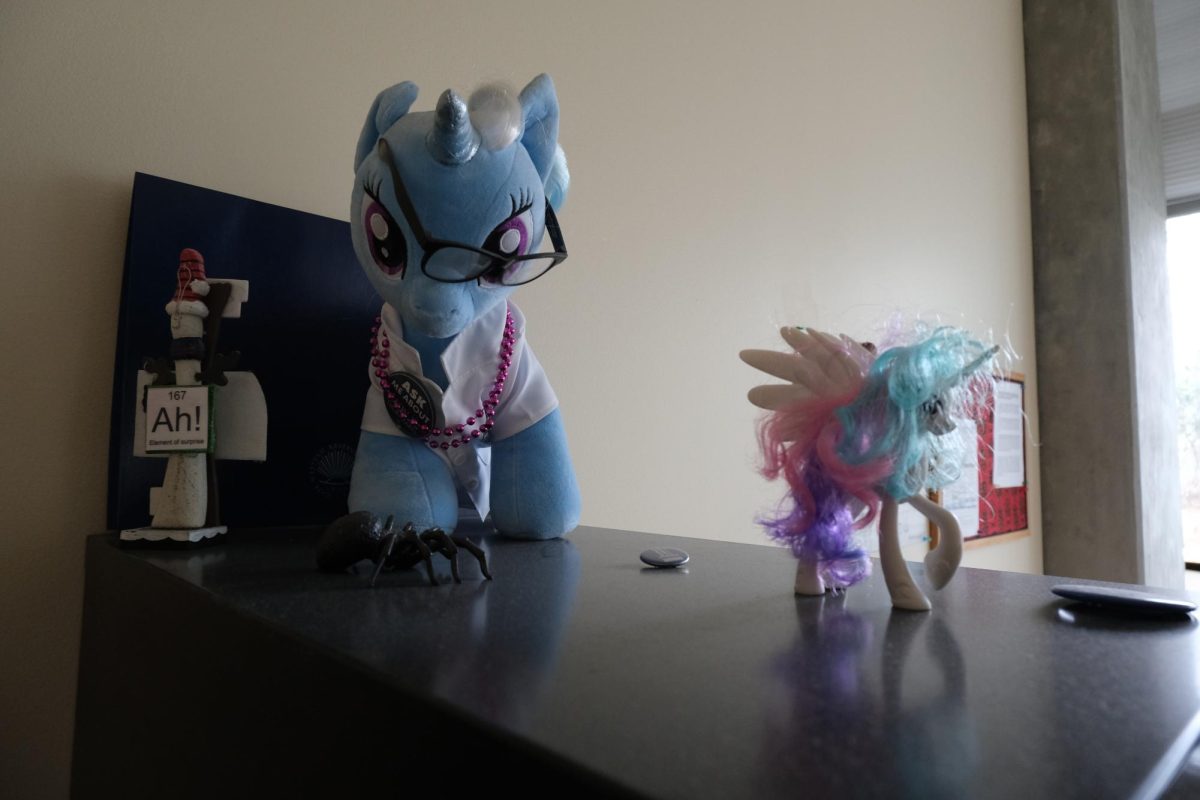
They sat perched around the room, small plastic figures and plush toys, with one particularly large one staring down at me through cockeyed glasses.
We began not with chemistry or ponies, however, with the coming winter storm. No one knew what to expect, and with Helene still fresh in memory, everyone seemed to prepare for the worst. He spoke of his home, his fear of frozen pipes and of all the concerns that may come to pass.
The office was dim, relying on sunlight that filtered weakly through the clouds before reaching the window. The building had little character of its own. That came from faculty offices, and this one was no exception.
The room was filled with small glimpses into his personality: chemistry jokes, odd pictures, a drawing of his wife and daughter, the seemingly obligatory periodic table that every chemistry teacher has. On the whiteboard next to me were some scrawled notes.

Schmeltzer appeared to be in his late forties, with short dark hair catching the sunlight. He wore glasses and a five-o’clock shadow, and he carried himself with an unassuming ease as he leaned back into his office chair. Whatever my own feelings for the subject, it was clear this man loved chemistry.

“Chemistry is kind of like magic,” he told me, in a drawn-out, confident voice that seemed to say ‘I know exactly what I am talking about.’ “It’s the study of changes in energy and kind of how it moves around.”
He had been teaching at UNC Asheville since the fall of 2005, a fact that surprised me.
“That’s quite a long time,” I said.
The doctor paused for a short moment. “I’ve had a number of students who have remarked upon this very thing,” he said with a smile. “I guess if I think about it, it is.”
Though originally from southeast Indiana, Schmeltzer seemed far happier in Asheville. “There’s not a lot there,” he said. “There’s like six hills in Indiana, and my dad’s backyard has three of them.” He prefers Asheville’s broken landscape. “There’s something about not being able to see that many miles into the horizon,” he explained.
For Schmeltzer, teaching is less about lectures and more about experience. According to him, the best way to learn science is to do it. He told me of an upcoming experiment where his students would pull metals from contaminated plant soil.
“It’s neat to see the projects the students put together,” he said. “Some of those projects are really cool.”
His passion, he told me plainly, is helping students learn.
Chemistry, he said, becomes more interesting when you understand the people behind it — the history, the relationships, the human interactions that shaped the science. That philosophy leads him to teach occasionally outside of his usual discipline and into the humanities. He expressed his hopes that it would make him a better teacher.
I asked him to tell me something interesting about himself. He paused once again, as if searching for something to say. He finally spoke.
“Oh, I don’t know,” he said. “I’m really kind of boring.” There was a moment of silence. I refrained from speaking, hoping he would continue.
“I sometimes wonder if I’m the tallest faculty member here,” he said at last.
To his credit, he was rather tall. He towered above me easily, and I’ve yet to meet another professor who looked taller.
It’s difficult to think of yourself as boring. Everyone wants to be someone interesting, but sometimes you become a chemistry professor and sometimes you become someone who writes about chemistry professors.

Eventually, the conversation circled back to the detail that had been impossible to ignore since I walked in.
“If you don’t mind my asking, what’s the deal with the ponies?” I asked.
“Oh, this is a schtick,” he admitted. His daughter, now a teenager, used to watch “My Little Pony” when she was younger. He watched it with her and found himself drawn in by the animation and storytelling. Later, he discovered there is a community of others like him — bronies, as they are called — and realized he was on the fringes of it.
The ponies are almost attempts to, as he put it, seem more human to his students. “With some students, it works,” he said, laughing. “Others just think it’s damn silly.”
I imagine plenty of people found it ‘damn silly.’ It certainly wasn’t something someone might expect from a professor. Yet, students would sometimes push the joke further.
Once, graduating seniors in his class made him a Build-A-Bear plush pony with a Chewbacca sound box inside. The voice box no longer worked, but the gesture clearly delighted him, and it remained prominently on display.

In the end, I had not met a man defined by ponies, by chemistry, or even those six hills in Indiana, half of which belonged to his father. He is defined by a commitment to teaching and a willingness to look a little silly if it helps make his students feel more comfortable. And maybe Schmeltzer is more interesting than he realizes.